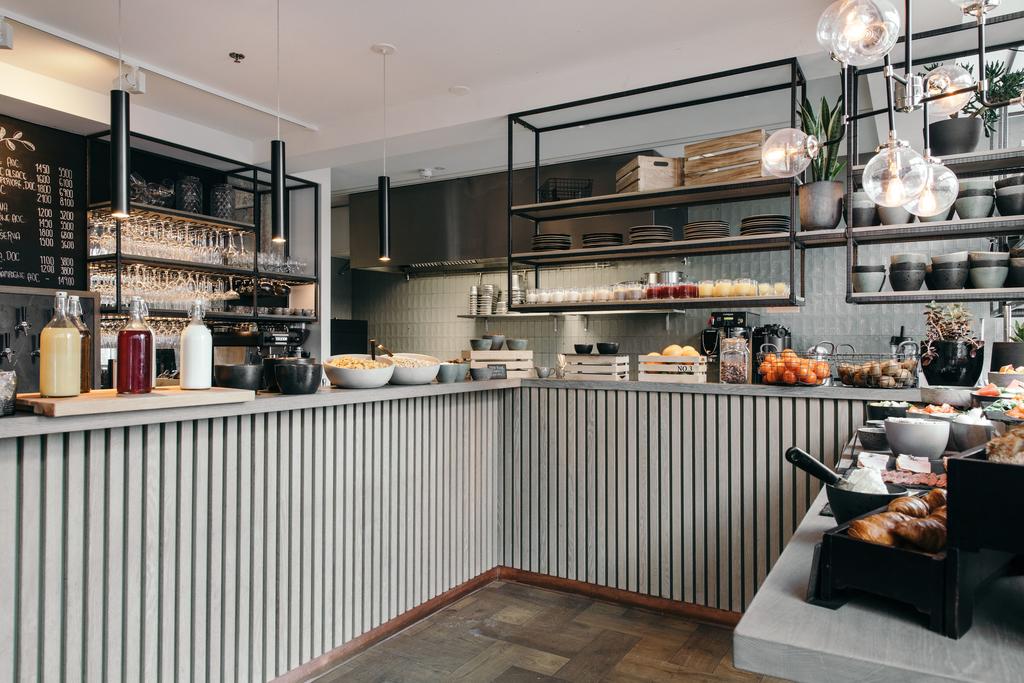
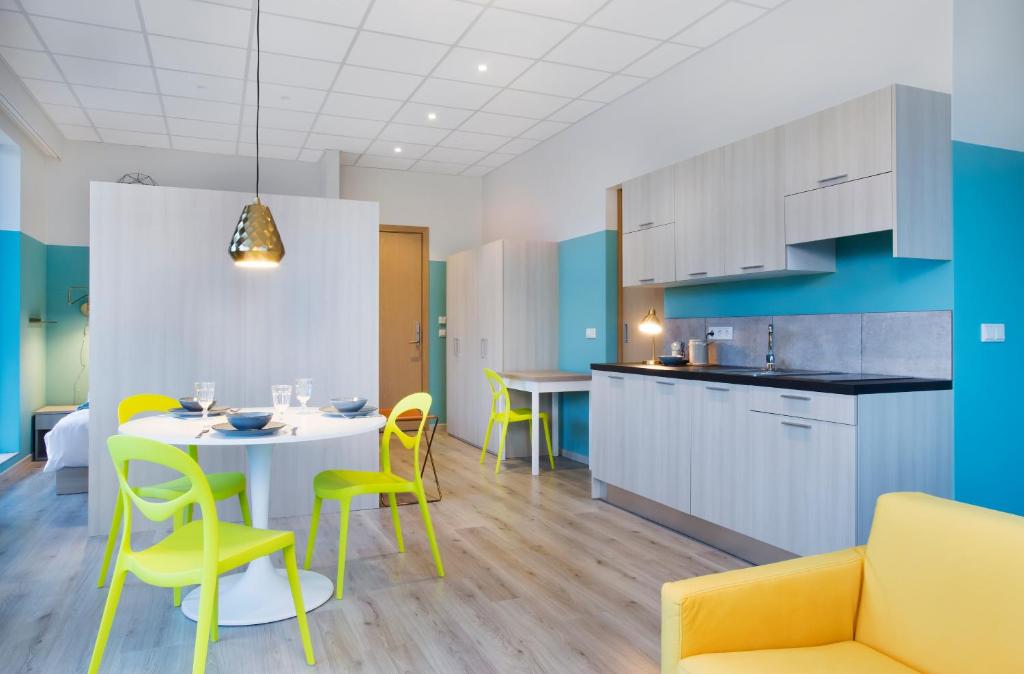
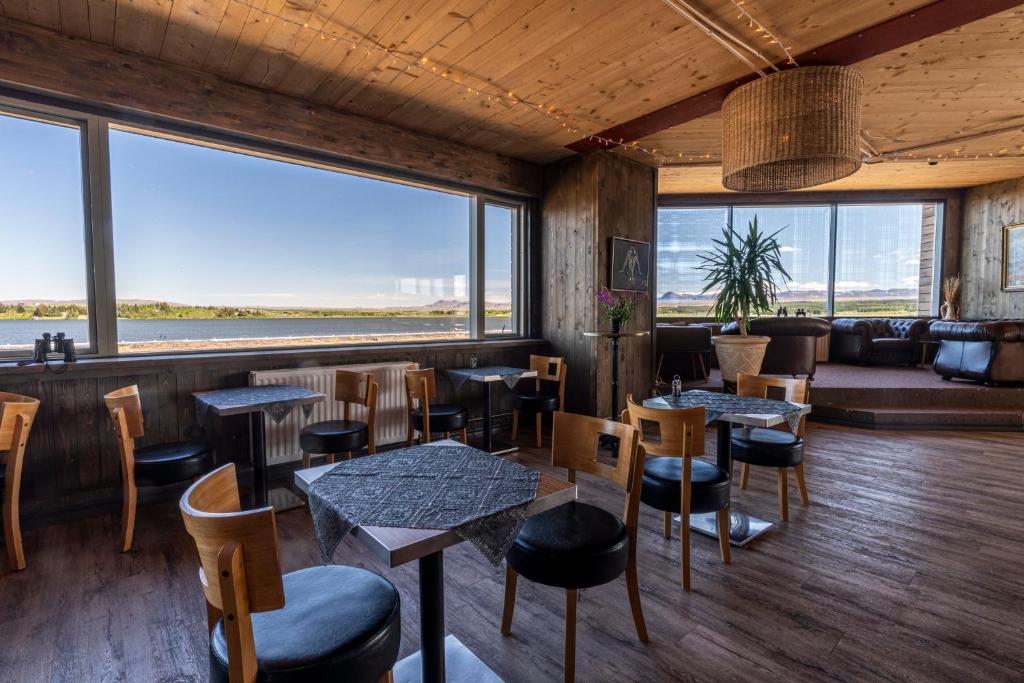
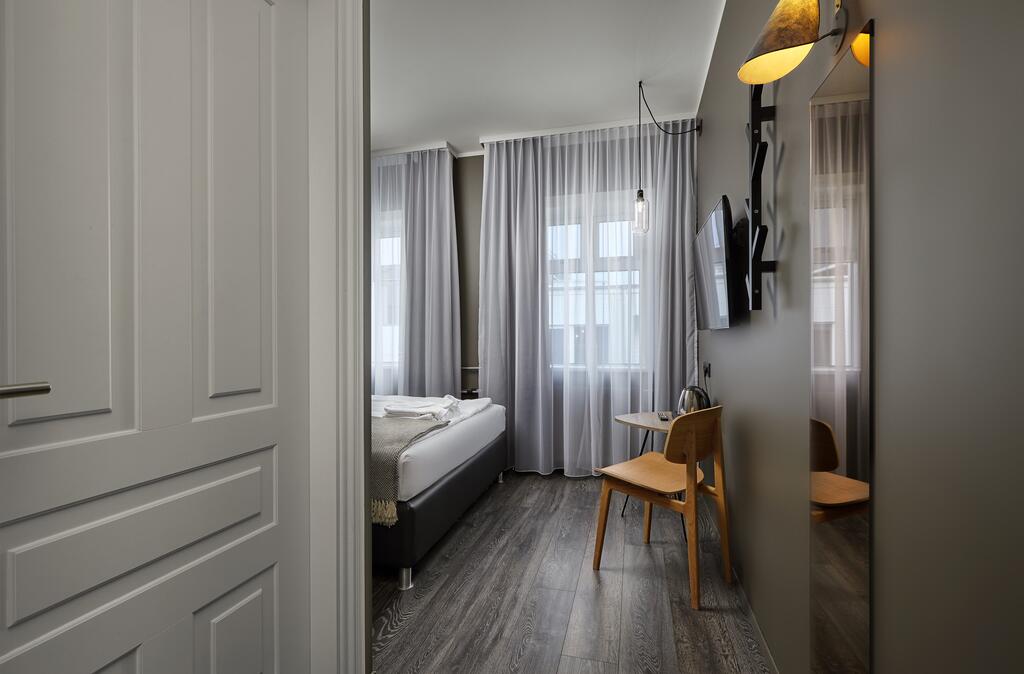
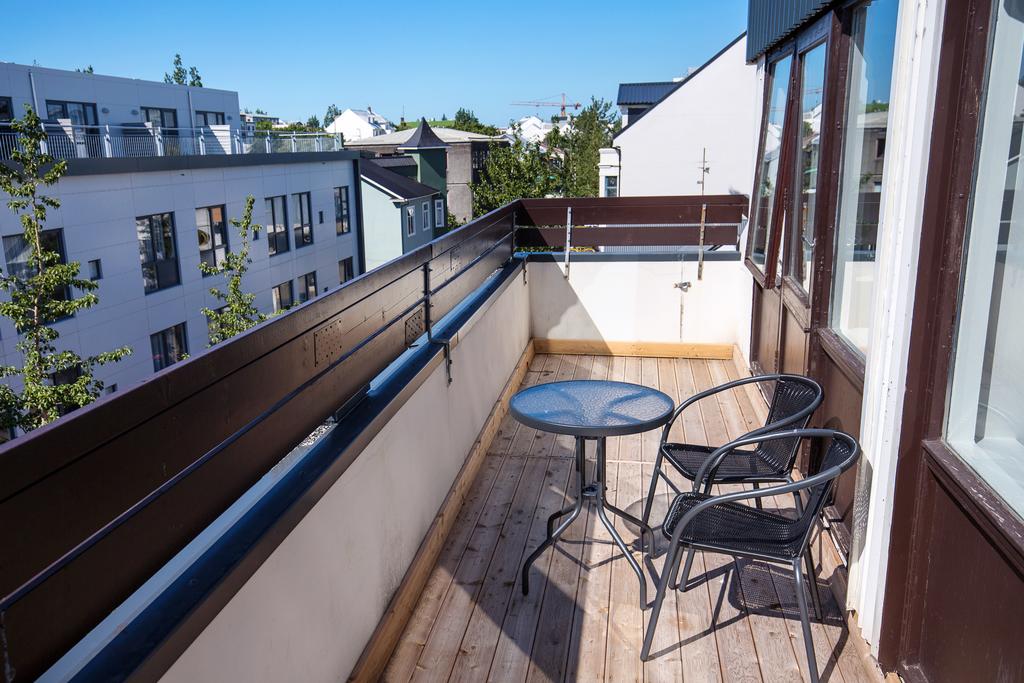
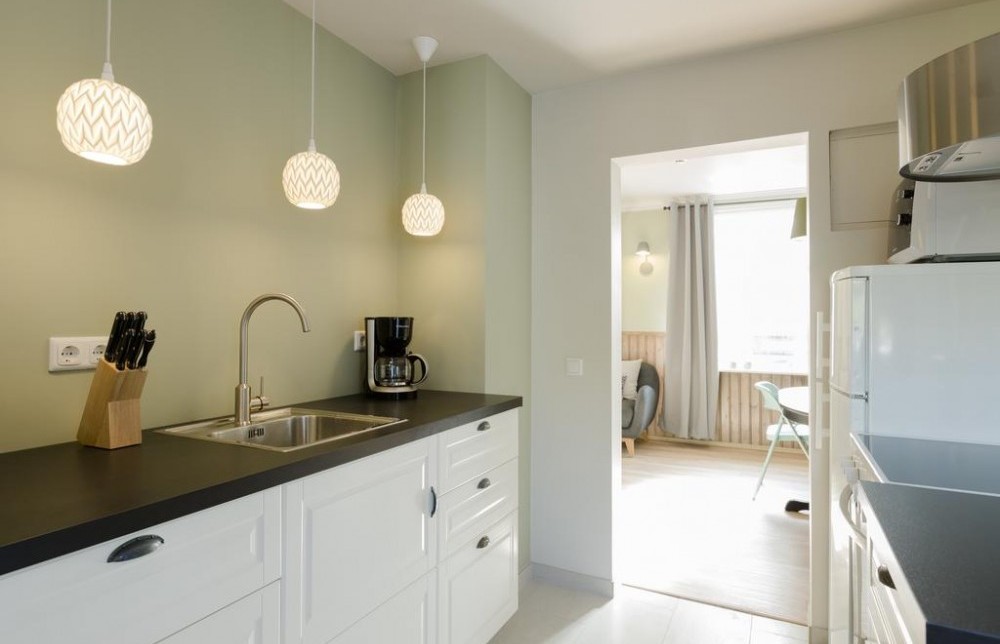
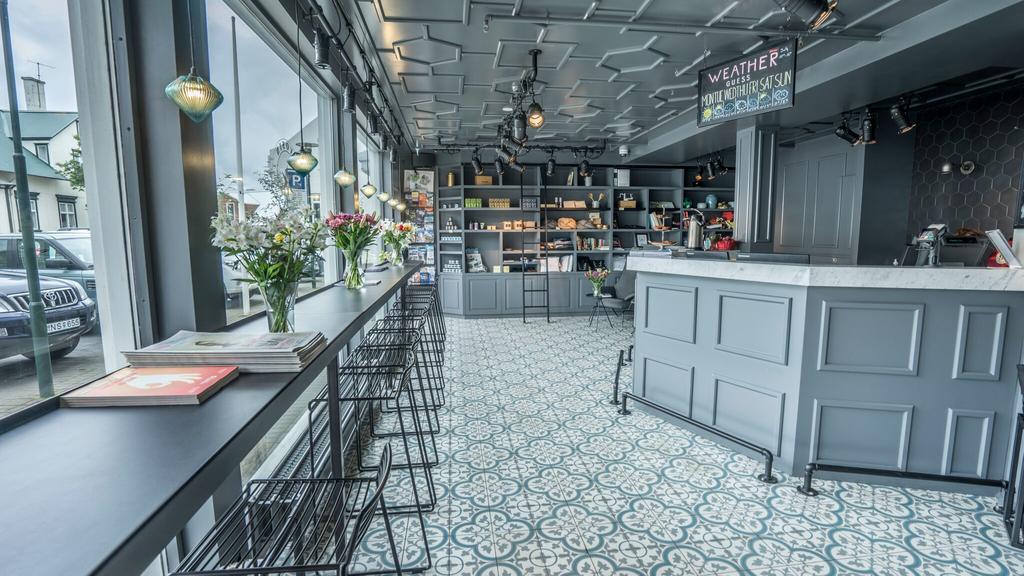
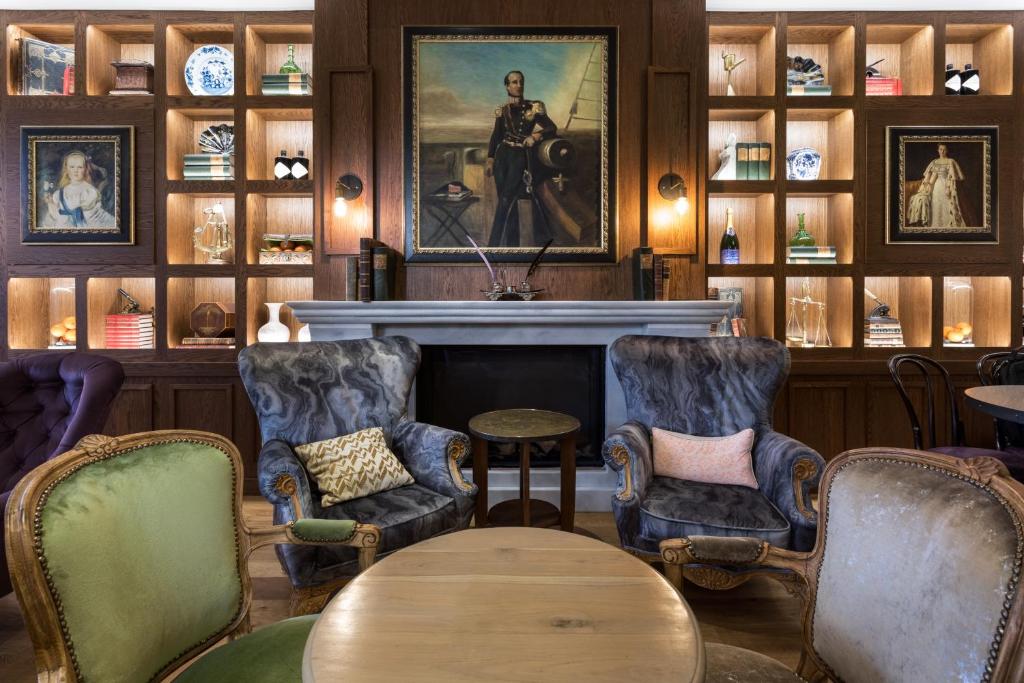
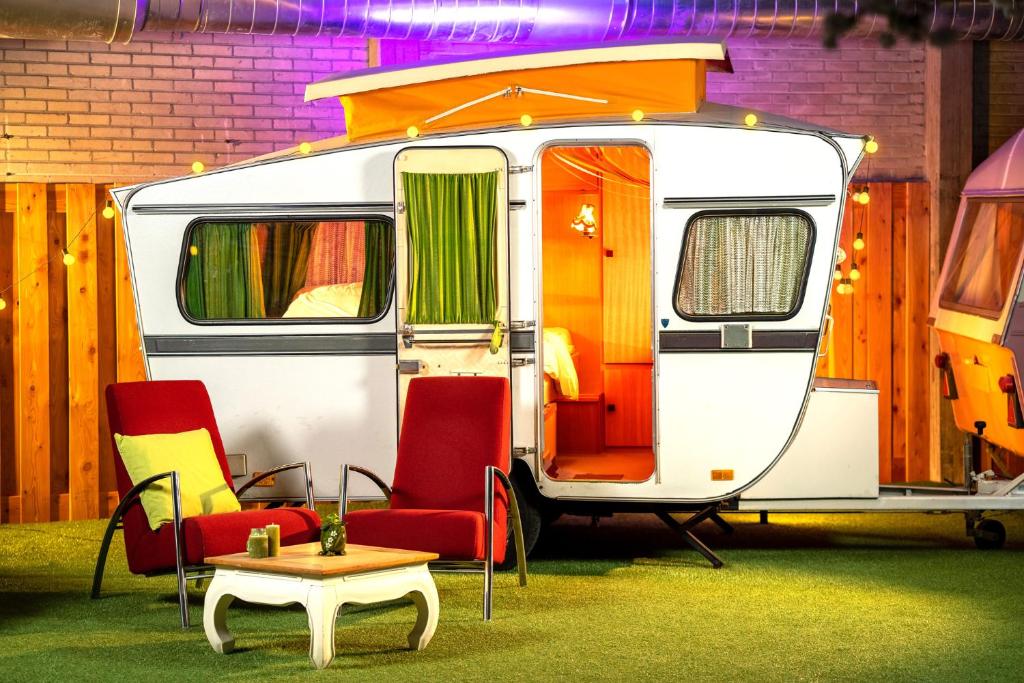
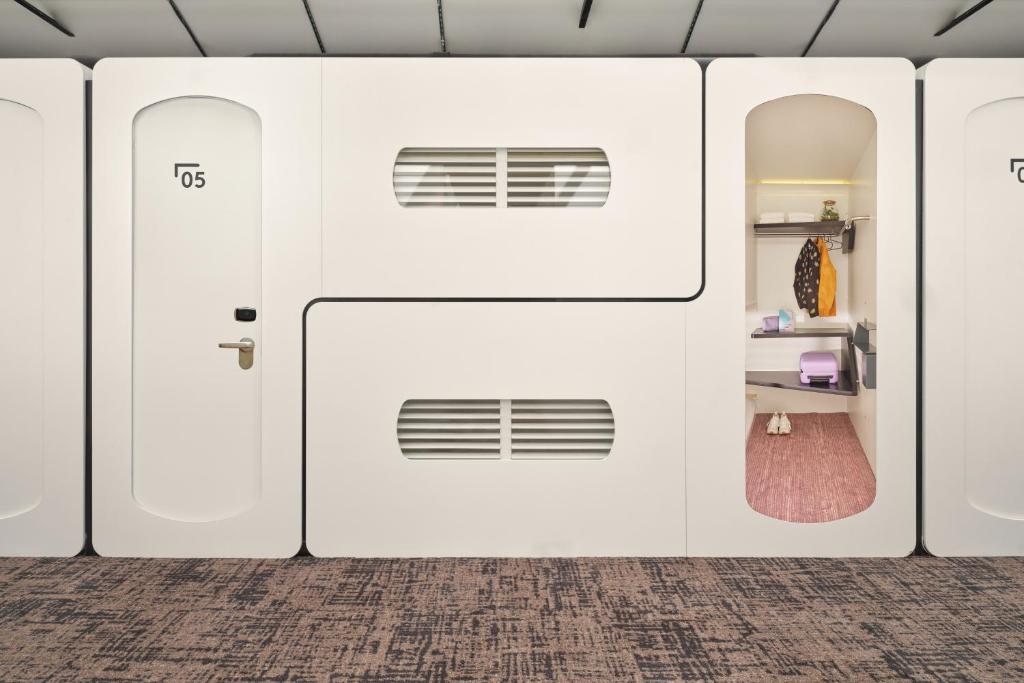
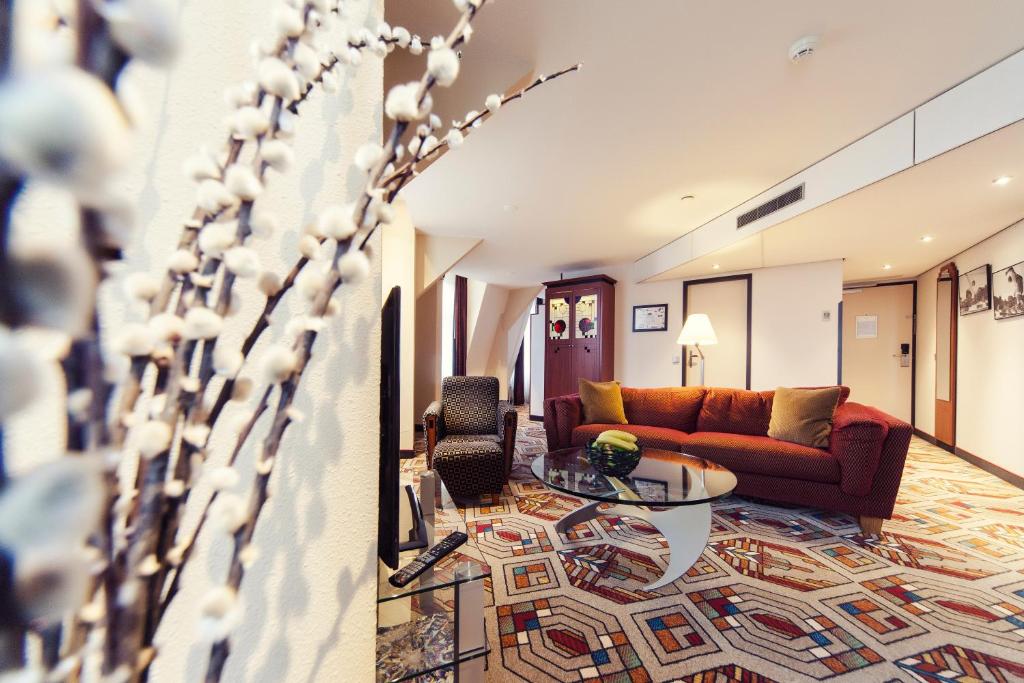
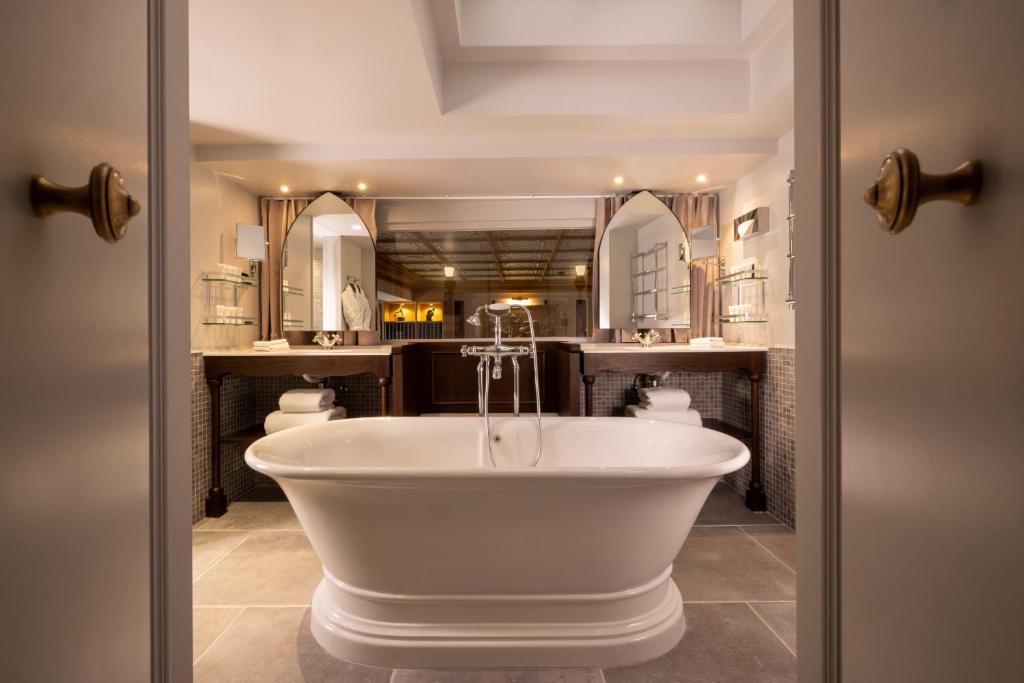
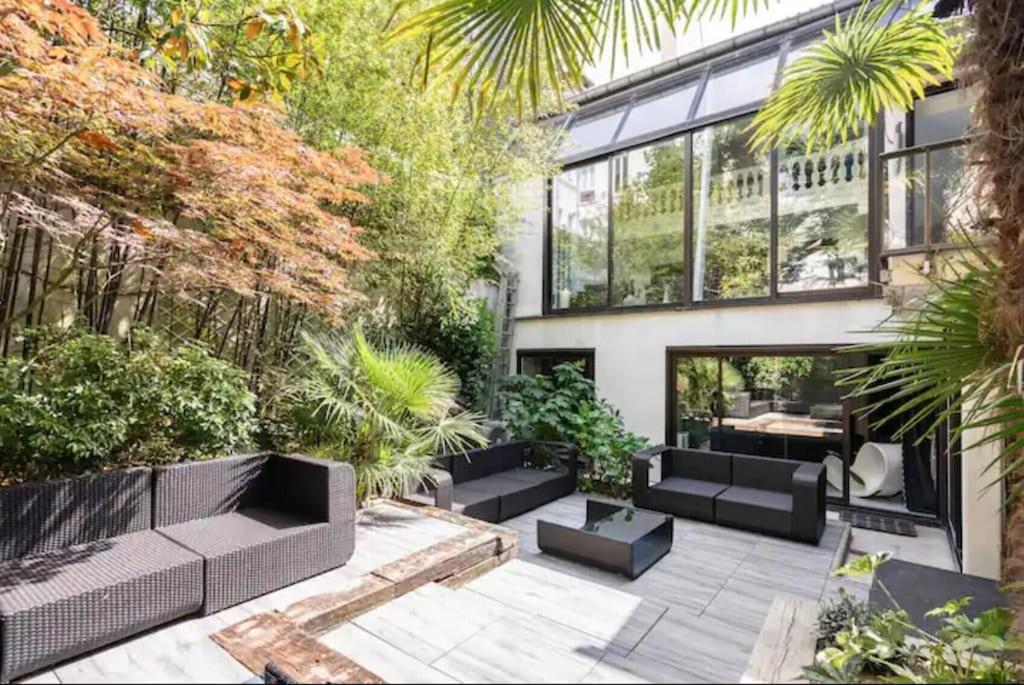
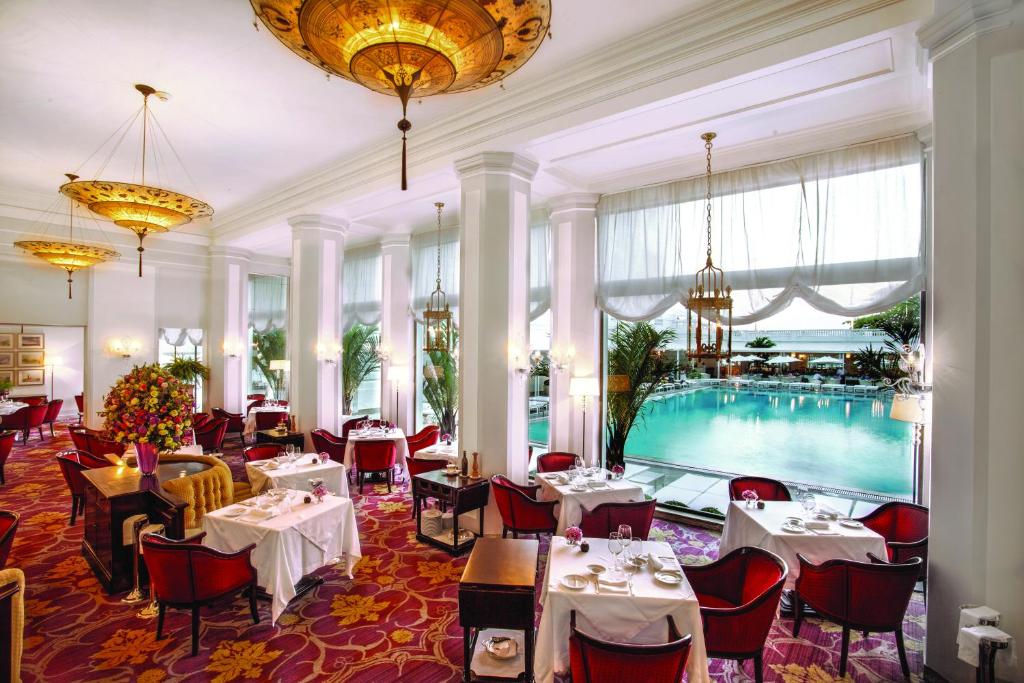
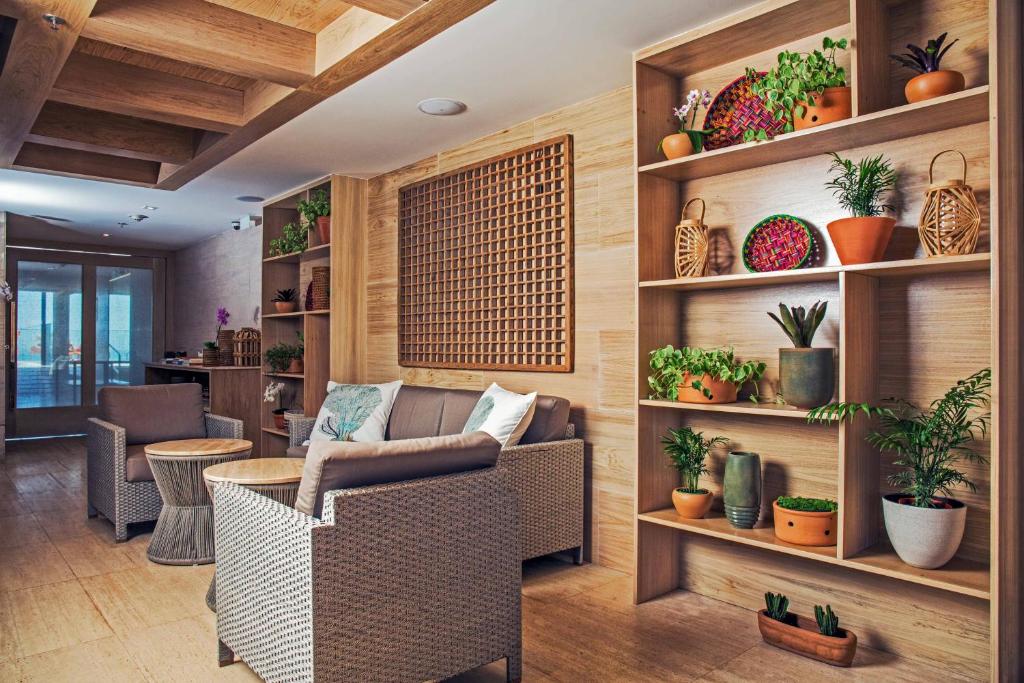
Reykjavik accommodations welcome you to a destination nicknamed “Land of Fire and Ice” and “The City of Sagas”. Known for its aurora borealis (Northern Lights) viewpoints, nightlife, music festivals, museums, Icelandic cuisine and puffins (seabirds), Reykjavik is the world’s northernmost capital city. Found on Faxaflói Bay, Reykjavik means “smoke cove”, “smoky bay” or “bay of smoke” in Old Norse. For a true Icelandic experience, it’s best to venture out from the city and explore Iceland when possible. Route 1, also known as the Iceland Ring Road, encircles the entire country for 821 miles. Route 1 begins and ends in Reykjavik.
When in Reykjavik, thermal clothing naturally comes in handy. Winter days can be dark for 20 hours straight. An upside to Reykjavik winters is that the best time to see the Northern Lights occurs in winter. Reykjavik’s currency is the Icelandic króna, cars travel on the right-hand side and the drinking age is 20 years old. Reykjavik accommodations are some of Northern Europe’s best. Before we get to Reykjavik accommodations, let’s take a look at some more background information on the area to help you along the way.
Legend has it that Ingólfr Arnarson (Bjǫrnolfsson), along with his wife Hallveig Fróðadóttir and his foster brother Hjǫrleifr Hróðmarsson, was Reykjavík’s first permanent settler circa 874 AD. As told in the Landnámabók, or The Book of Settlements. Arnarson hailed from western Norway’s Rivedal valley in Sunnfjord. The legend was disputed, however, by Icelandic medieval chronicler Ari Þorgilsson. Þorgilsson suggested that although Arnarson was the first Norse settler, Irish monks had actually arrived beforehand. According to Þorgilsson, the monks departed because they did not want to live amongst Norse pagans. Regardless, Arnarson is thought to have chosen the Reykjavik area by using the traditional Norse method of using high seat pillars (Öndvegissúlur), while favoring Iceland’s natural thermal baths. Arnarson’s settlement remained farmland until the 18th century. Following the dismissal of the Danish governor, Skúli Magnússon became the first Icelander to be appointed bailiff, or senior representative of the Danish crown, in 1749. With royal permission from King Frederick V of Denmark, Magnússon established the Innréttingar corporation in 1752 to promote industrial development in Iceland. Wool, fish and fur became the new industrial city of Reykjavik’s first products. Magnússon built Iceland’s first stone house, Viðeyjarstofa Manor House, on Viðey Island between 1753 and 1755. Iceland’s first prison, Stjórnarráðshús, opened in Reykjavik in 1764. Monopoly trade was abolished in Iceland circa 1786, and the Danish Crown granted Reykjavik a town charter that marked the official founding of the town as a trading center. In 1796, the Reykjavík Cathedral was consecrated. Prior to 1880, the year when a Danish trade monopoly over Iceland officially ended, Iceland’s trading rights were limited to Danish Crown subjects. After 1880, local industries helped to promote Icelandic merchant influence, and Reykjavik became the primary port for Icelandic commerce. World War II Allied powers, in particular British warships, occupied Reykjavik following Germany’s invasion of Denmark & Norway, April 9, 1940. Allied presence (British and later American) was actually beneficial during the Second World War. The British built Reykjavík Airport, while the Americans built Keflavík Airport. Establishing the country as a republic and a parliamentary democracy, the Constitution of Iceland was adopted on June 17, 1944. Reykjavik hosted the 1972 World Chess Championship between Bobby Fischer and Boris Spassky. In 1986, Ronald Reagan and Mikhail Gorbachev met at the Reykjavík Summit, a catalyst to the 1987 Intermediate-Range Nuclear Forces Treaty.
Iceland’s capital and largest city, Reykjavík is home to around 140,000 “Reykvíkingurs”. Over 60% of Iceland’s population lives in Reykjavik. One of the world’s cleanest and safest cities, Reykjavik is surrounded by a variety of natural landscapes to include fissures, lava fields, volcanoes, countryside, canyons, mountain ranges, nature preserves, forest trails, thermal baths, geothermal geysers, waterfalls and islands. Reykjavik’s tallest building is Hallgrímskirkja at 244 feet. Bars typically remain open until about 4:30 AM on the weekends and 1 AM on the weekdays. Home to a subpolar oceanic climate, Reykjavik experiences cool summers and relatively mild winters. July summer highs average just below 59 °F, while January winter highs average just below 38 °F. The record low is -12.1 °F whereas the record high is 78.3 °F. Reykjavik experiences nearly-permanent daylight from about mid-May to late-July, and nearly-permanent darkness from early-December through early-January. Local foods include hangikjöt (smoked lamb), skyr (cultured dairy product), kleinur (fried dough), laufabrauð (traditional Christmas bread), bollur (pastry) and of course fish / seafood,. Iceland’s signature distilled spirit is brennivín (“Black Death” – clear, unsweetened schnapps). Other popular alcoholic drinks are vodka and Icelandic beer (predominately lager). With some background information on the area, we’re ready for Reykjavik accommodations that will help make for a uniquely unforgettable experience.
So there they are, Reykjavik accommodations that will help make for an outstanding experience. We hope you have found this information valuable and most of all, that you enjoy your time in Iceland!
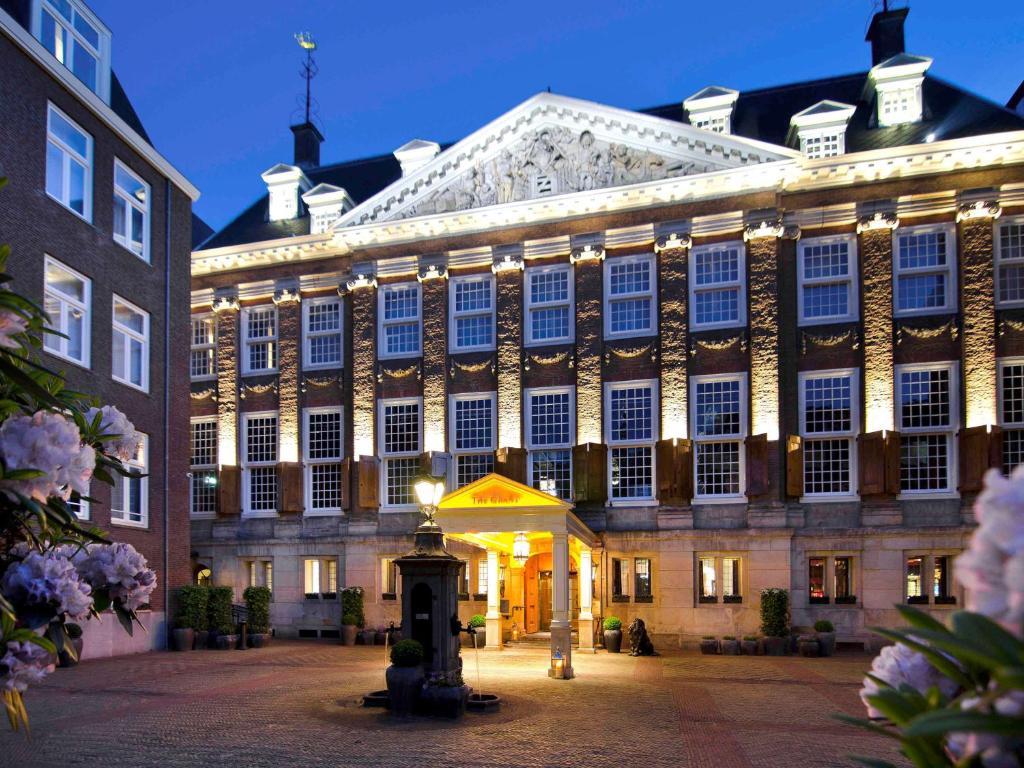
Amsterdam accommodations welcome you to a destination nicknamed “Venice of the North”. Known for its museums, art galleries, theaters, castles, event venues, canals, narrow canal houses, bridges, parks, wind mills, cafes, coffee shops (cannabis), red-light district and tulips, Amsterdam is located in northern Netherlands, 33 miles northeast of The Hague (seat of the Dutch government), 82 miles northeast of Antwerp (Belgium) and 133 miles northwest of Dortmund (Germany). Across The North Sea from England and via the man-made North Sea Canal, or Noordzeekanaal, Amsterdam’s waterfront is known as The IJ. Flowing through Amsterdam is the Amstel, a North Holland province river. The Amstel rises just north of Nieuwveen (village) and empties into a former bay just past Stationseiland (artificial island – site of Amsterdam Centraal Station).
Amsterdam’s most renowned football club is AFC Ajax, which plays at Johan Cruijff Arena on the city’s southeast side. One of the world’s most English-friendly cities, Amsterdam boasts a high English proficiency level. About 90% of the city’s population speaks English. Although Amsterdam’s population is generally considered friendly, one should nevertheless remain vigilant, especially in places around the red-light district. Be sure not to smoke cannabis, or drink alcohol, in public places, and stay out of bicycle paths. Apart from cannabis, also legal in Amsterdam are magic truffles (less-potent magic mushrooms) and prostitution. De Wallen, Amsterdam’s largest red-light district, is located at medieval city center. Otherwise neon-lit, De Wallen, with its canals, narrow alleys and bars, is worthy of at least a day-time stroll. While in the red-light district, one should not take pictures of sex workers or linger in front of brothel windows. Generally in Amsterdam, its best to keep your belongings secure and avoid chewing gum while speaking. During dinner, do not leave the table unnecessarily. Amsterdam’s currency is the Euro, cars travel on the right-hand side and the drinking age is 18 years old. Amsterdam accommodations are some of northern Europe’s best. Before we get to Amsterdam accommodations, let’s take a look at some more background information on the area to help you along the way.
Dating as far back as 2750 BC, Neolithic and Roman artifacts (Beaker culture pottery & a granite grinding stone) have been discovered in Amstel river bedding beneath Amsterdam’s Damrak and Rokin areas. By about 1000 BC, farmers are believed to have settled along the IJ River. However, a catastrophic event in 1170 AD known as the All Saints’ Flood overflowed large parts of Northern Netherlands and Holland territories. In essence, the flood was responsible for creating modern Amsterdam and its canals, while connecting the area to the open sea. The flood also shifted production from farming to trade. Amestelle was once a 13th-century dam on the Amstel River. During the Middle Ages’ Protestant Reformation, Amsterdam became a popular pilgrimage destination. Amsterdam began to flourish in the 14th century due largely to its trading with the Hanseatic League, a medieval network of merchant guilds and market towns. The Hanseatic League was cut-off in the 15th century, however, on account of a newly established Dutch trade route. Independent from the Hanseatic League, this Baltic Sea trade route guided grain and timber ships. Also around this time, demand for herring spread across Europe. Amsterdam benefitted from its innovations in the the herring fishery, along with its capacity for handling bulk cargo. Moreover, in 1415, on-board gibbing (process of preparing salt herring) and the haringbuis (seagoing fishing vessel) inventions gave the Dutch a monopoly on the herring trade. There is a saying, “Amsterdam is built on Herring bones”, which derives from the city’s transcontinental herring trade system. This trade system helped pave the way for what would become the Dutch Golden Age. In the late-16th century, however, the Spanish-Hapsburg monarchy took control of “The Low Countries”, or Netherlands. The Eighty Years’ War, also known as the Dutch Revolt, was caused by new taxations and religious persecution of Protestants. The war resulted in Dutch independence from Spain. Fleeing from Catholic-Spain’s religious inquisitions, Iberian Peninsula Jews, French Protestant Huguenots and prosperous merchants and printers from Flanders found refuge in Amsterdam. The Dutch Golden Age was revived, and reached its peak, during the 17th century. Amsterdam became the Western world’s wealthiest city. The Dutch East & West India Companies, together spanning almost the entire world, acquired vast overseas possessions. Thus, the Dutch colonial empire was established. Trading its own shares, Amsterdam’s Dutch East India office became the world’s first stock exchange in 1602. The Bank of Amsterdam, which served as a full-service bank and reserve bank for Dutch merchant bankers, was founded circa 1609. Amsterdam was involved in the Atlantic slave trade during the 17th century. The city’s port was a major destination for Dutch slave ships. Amsterdam declined to its lowest level during the 18th and early-19th centuries on account of the Napoleonic Wars. Holland was absorbed into the French Empire. However, a new pseudo-Golden Age ensued in 1815 with the establishment of the United Kingdom of the Netherlands. Museums, railway systems and a concert hall were constructed, and the Amsterdam–Rhine and North Sea canals were dug. The canals provided Amsterdam with unprecedented nautical access to mainland Europe, as well as the United Kingdom and Scandinavia. During World War I. Amsterdam suffered from food shortages. After the First World War the city recovered and even expanded until May 10, 1940, when Nazi Germany invaded and took control of the Netherlands. During Nazi occupation, Anne Frank hid in the “Secret Annex ” at the back of her father Otto’s business premises on the Prinsengracht canal, but ultimately was discovered and sent off to concertation camps. Akin to the First World War, Amsterdam’s food, and also fuel, supplies were scarce by the end of World War II. Sugar beets, tulip bulbs and even cats and dogs were cooked to a pulp and consumed for survival purposes. On May 5, 1945, Canadian forces liberated Amsterdam. Although prostitution has existed in De Wallen (red-light district) since around 1270, the area’s red-lit windows date to the 1960s. Thriving to this day, the city’s cannabis coffee shops started appearing in the 1970s. Amsterdam’s first coffee shop, Mellow Yellow, opened in 1972. Amsterdam’s first skyscraper, Rembrandt Tower, was completed in 1994. Amsterdam prostitution was formally legalized in 2000. Around 10 million people visited Amsterdam in 2012. Five years later, annual visitation eclipsed 17 million people.
The Netherlands’ capital and most populous municipality, Amsterdam today is home to around 850,000 “Amsterdammers”. Over 60 miles of canals, 1,500 bridges and nearly 90 islands help inspire the city’s nickname, Venice of the North, where houseboats are commonplace. Amsterdam’s canals undoubtedly served as inspiration for two of the city’s most famous inhabitants, Rembrandt and Vincent Van Gogh. Not far south of Amsterdam Centraal Station is De Wallen. Amsterdam’s cruise port is located on the IJ River also near Amsterdam Centraal Station. Cruise lines operating in Amsterdam include Royal Caribbean, Norwegian Cruise Line, Celebrity Cruises and MSC Cruises. Schiphol Airport often ranks as Europe’s third-busiest airport. Amsterdam’s tallest buildings are Rembrandt Tower (492 feet) and Mondriaan Tower (403 feet). Several publicly-traded companies have based their European headquarters in Amsterdam. Defined by an oceanic climate, Amsterdam experiences moderate, sometimes hot, summers and fairly mild winters. August summer high temperatures average just over 72°F, while January winters stay just above 43°F. Snowfall typically is minimal. Additional points of interest are Dam Square, Grachtengordel (historic district – 17th-century canals, architecture), Keizersgracht canal, Reguliersgracht canal, Rembrandtplein (square), Hortus Botanicus (botanical garden), Eye Filmmuseum, Stedelijk Museum Amsterdam, H’ART Museum, Royal Theater Carré, Stadsschouwburg (theater), Royal Concertgebouw (concert hall), Zuidas (business district), Euronext Amsterdam, Westerkerk (Protestant church) and University of Amsterdam. Local foods include herring, cod, kibbeling (battered fish), stamppot (mashed potatoes mixed with vegetables), Gouda cheese, Dutch pancakes (thinner, crepe-like – topped with fruit), stroopwafel (wafer cookie), oliebol (fried dough) and rijsttafel (Indonesian-inspired array of small plates). Popular drinks are vodka, jenever (juniper-flavored liquor), advocaat (eggnog-like, brandy-infused custard) and lager beer. With some background information on the area, we’re ready for Amsterdam accommodations that will help make for an exciting trip.
Hotel amenities: bar, buffet, à la carte or continental breakfast, fitness center, free Wi-Fi, air conditioning, safety deposit boxes, hairdryers, 24-hour front desk, luggage storage space, private parking
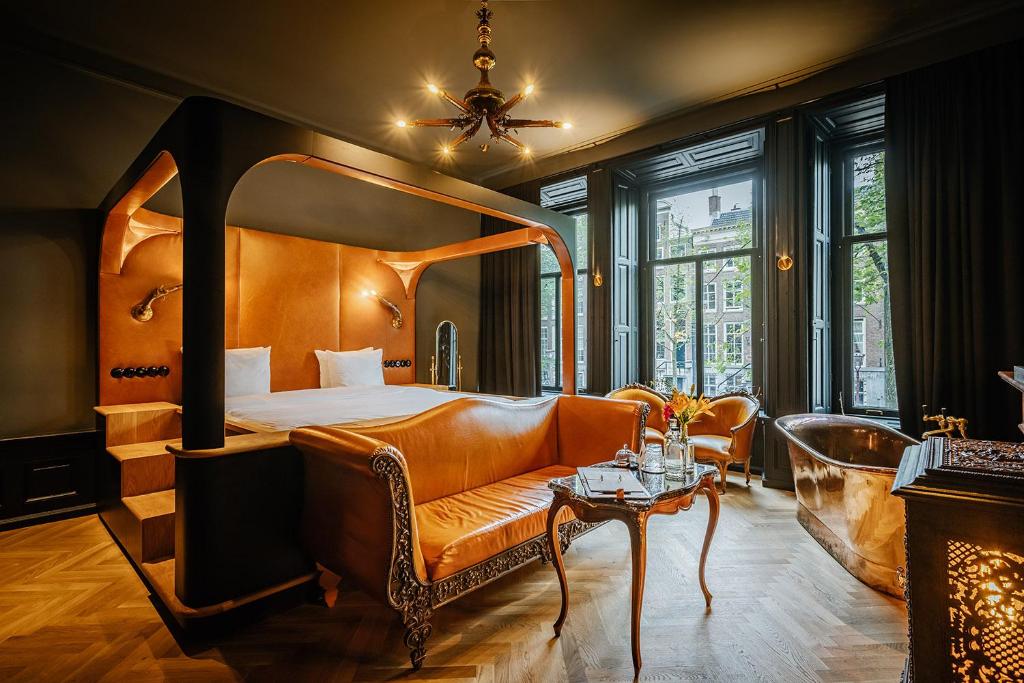
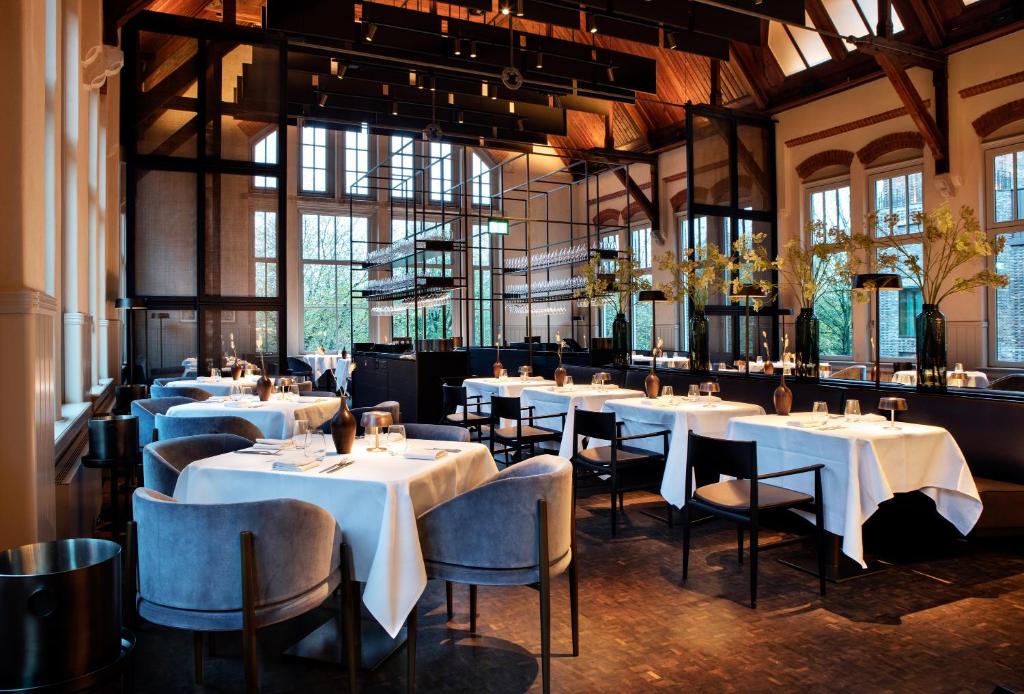
Hotel amenities: bar, fitness center, canal / garden views, free Wi-Fi, air conditioning, flat-screen TVs, coffee machines, walk-in rain showers, bathrobes, slippers, 24-hour front desk, meeting room, fire place
Hotel amenities: bar, sun terrace, city views, free WiFi, air conditioning, flat-screen TVs, kettles, bathrobes, slippers, 24-hour front desk, private paid parking
Hotel amenities: bar, snack bar, buffet, à la carte or continental breakfast, fitness center, free Wi-Fi, air conditioning, flat-screen TVs, electric tea pots, desks, safety deposit boxes, private parking, 24-hour front desk, luggage storage space
Apartment amenities: snack bar, buffet / continental breakfast, fitness center, city views, free Wi-Fi, air conditioning, flat-screen TVs, kitchens, coffee machines, kettles, safety deposit boxes, walk-in showers, hair dryers, 24-hour front desk, private parking for an extra charge
Nearby: Local Flavour (restaurant) and De Mooiste Markt (florist)
Hotel amenities: bar, free Wi-Fi, air conditioning, flat-screen TVs, iPod docking stations, mini-bars, tea / coffee making facilities, shuttle service (extra charge)
Hotel amenities: bar, full English/Irish buffet breakfast, free Wi-Fi, flat-screen TVs, desks, coffee / tea making facilities, rain showers, shared lounge, fireplace, 24-hour front desk
Hotel amenities: international live-cooking breakfast, stained glass windows, dark-wood furniture, art deco designs / original features, air conditioning, flat-screen TVs, free private mini-bars with luxurious cut-glass decanters of whiskey, cognac and gin, rain showers, pillow menus, lounge with large armchairs, free drinks, snacks and cheese platters, tour desk
Hotel amenities: bar, a la carte breakfast, ‘silent garden’, chandeliers, ceiling paintings, classic décor, air conditioning, flat-screen TVs, mini-bars, bathrobes, tea / coffee making facilities, lounge
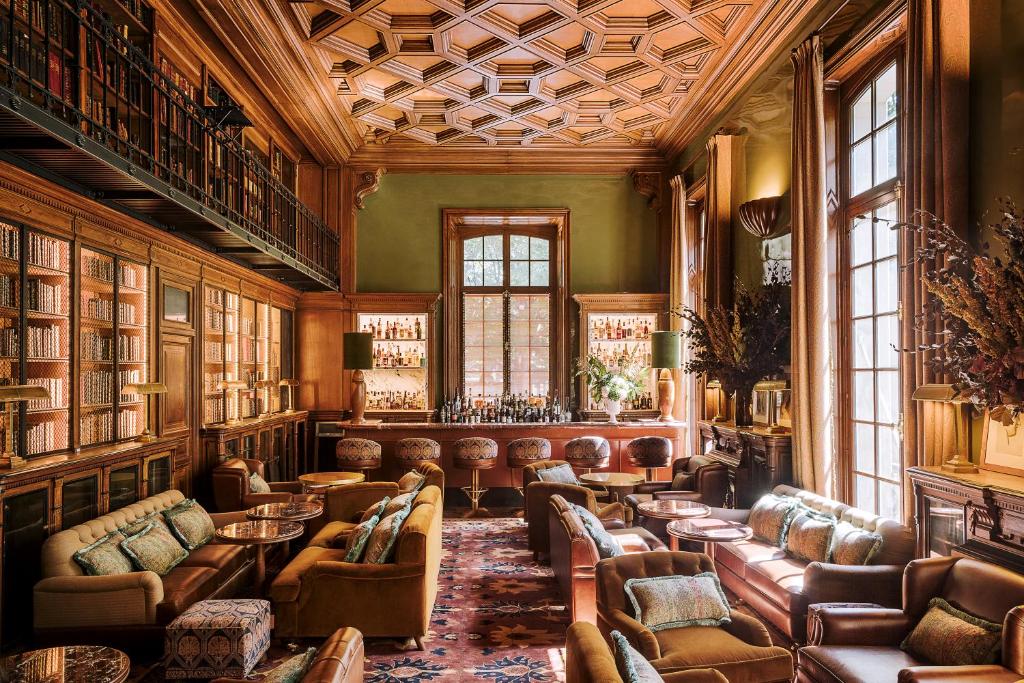
Hotel amenities: brasserie, library bar, breakfast buffet, flotation center, unique rooms, luxurious décor,1950-CoBrA movement art work, Louis XV furnishings, air conditioning, free Wi-Fi, satellite TVs, desks, 2 elevators
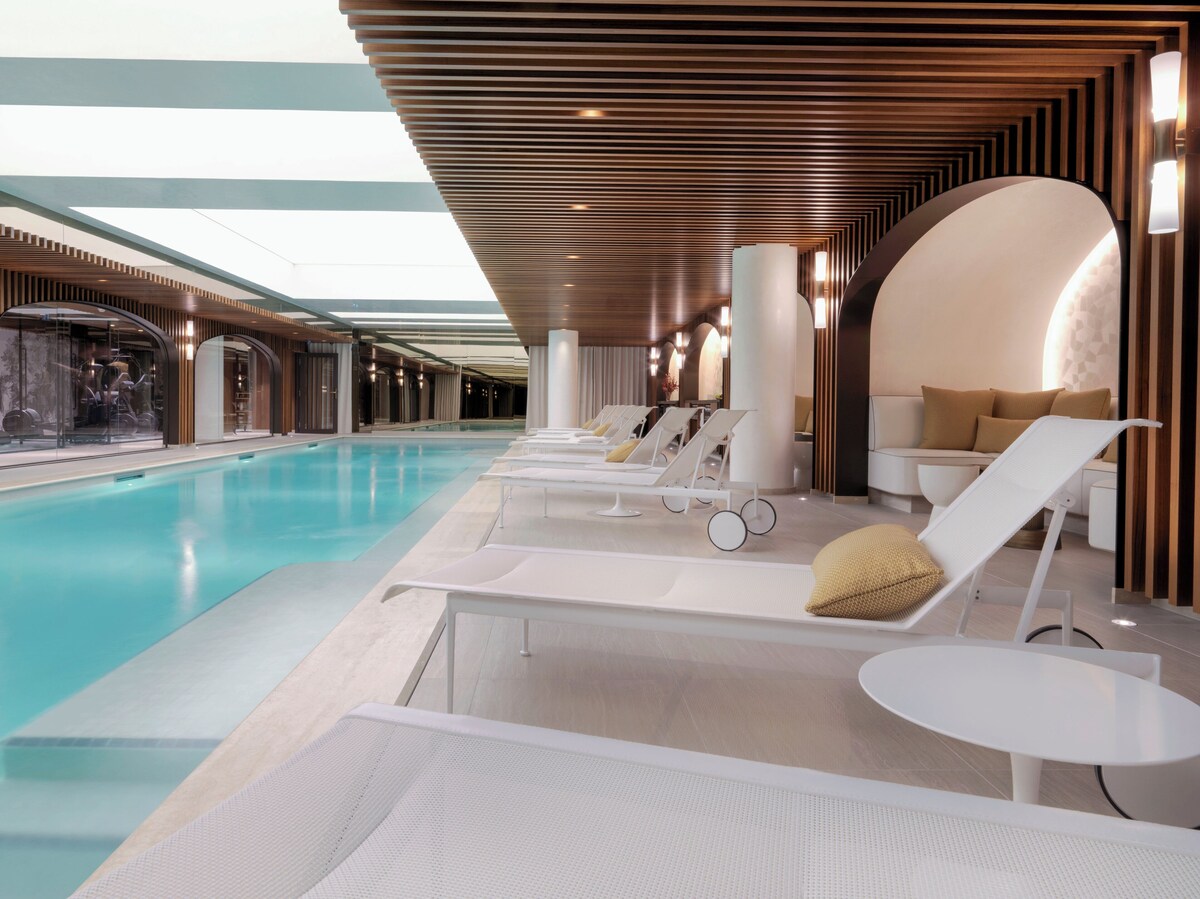
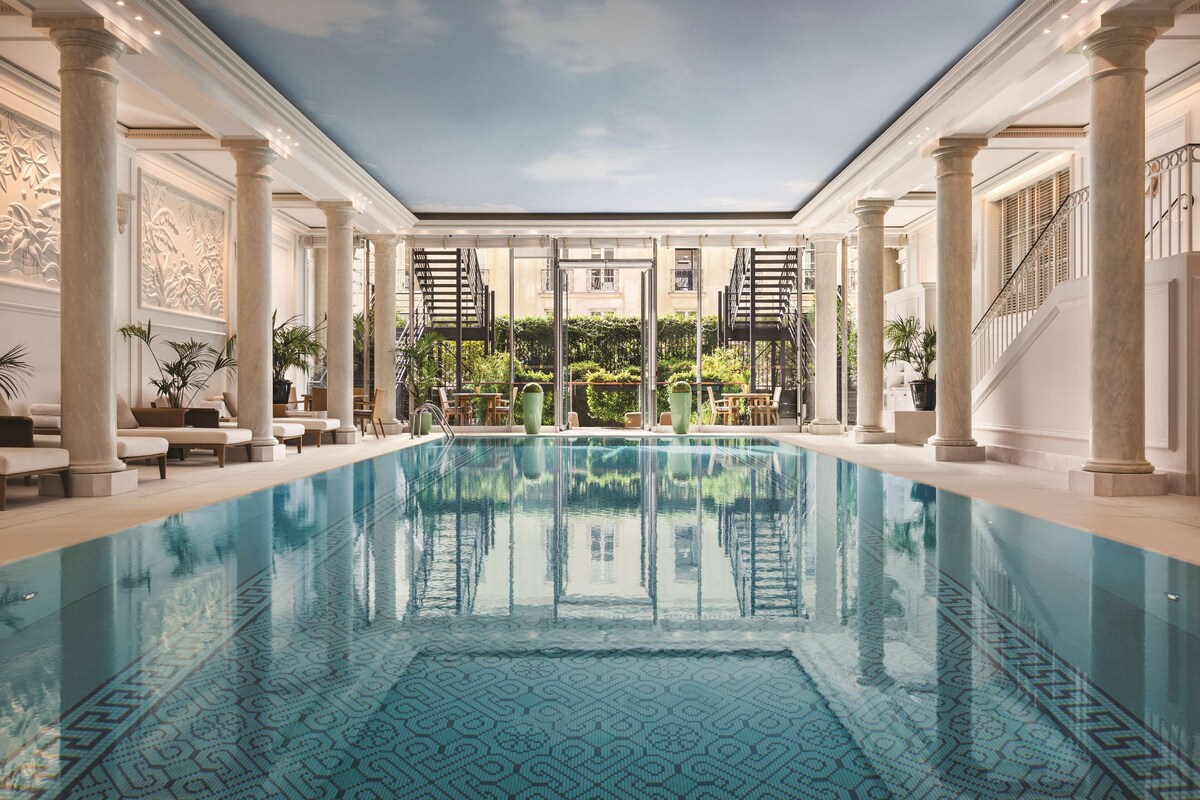
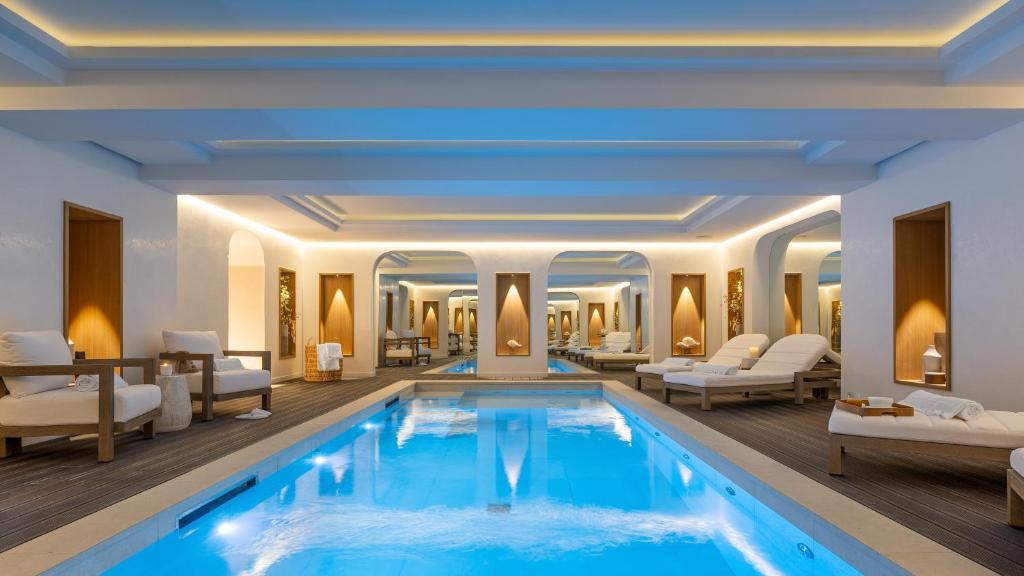
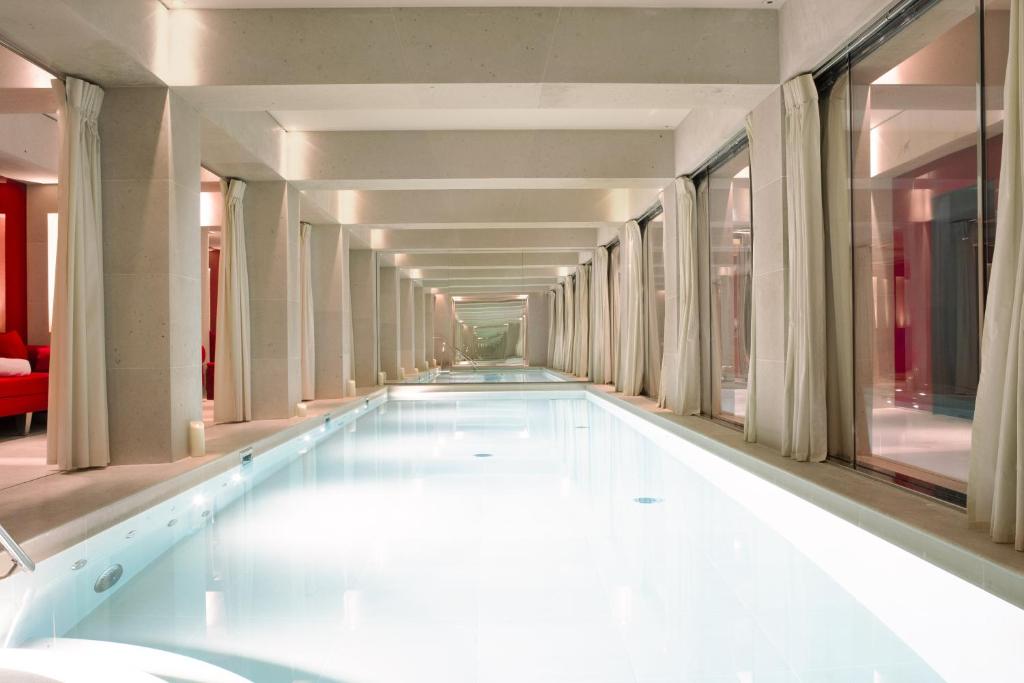
Hotel amenities: fine dining restaurant, multiple bars, terrace, garden, indoor pool, spa, sauna, hammam, fitness area, French style, free Wi-Fi, rain showers, slippers, butler service
Hotel amenities: terraces, city views, sauna, free Wi-Fi, air conditioning, flat-screen TVs, coffee machines, safety deposit boxes, hairdryers, à la carte, continental or gluten-free breakfast
Nearby misc.:Wereldmuseum Amsterdam (museum), Oosterpark Music Dome (live music venue), paradijs (ice cream shop), Voormalig bolwerk Muiden (historical landmark)
So there they are, Amsterdam accommodations that will help make for an unforgettable experience. We hope you have found this information valuable and most importantly, that you enjoy your time in the Netherlands!
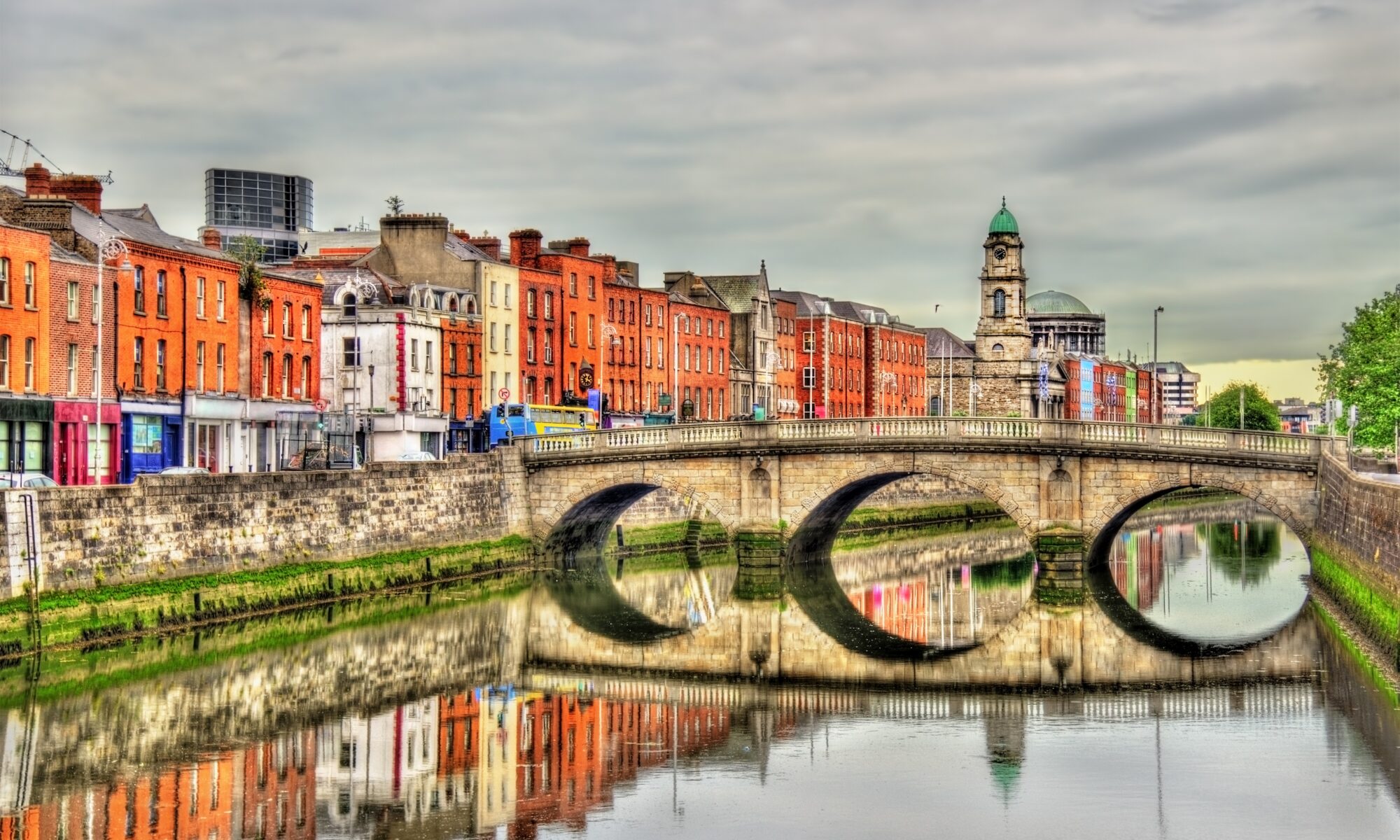
Dublin accommodations welcome you to a destination nicknamed “The Fair City”. Known for its castles, historic estates, churches, museums, monuments, parks, gardens, bridges, breweries, distilleries, pubs, horseracing venues and golf courses, Dublin is located on Ireland’s northeastern coast, about a 2-hour drive from Belfast, Northern Ireland. Across the Irish Sea and past the Isle of Man is the English city of Liverpool. Flowing through central Dublin, the 80-mile long River Liffey rises at the Liffey Head Bog in the Wicklow Mountains and empties into Dublin Bay. Not far south of city-center, the Dublin Mountains’ Kippure peak rises to 2,484 feet above sea level.
Speed limits are strictly enforced in Ireland. Dublin Uber is connected to taxis, though it does also offer Uber Black service. FreeNow is another Dublin taxi-hailing app.
Dublin’s professional football clubs are Shamrock Rovers, St. Patrick’s Athletic and Bohemian FC, while its rugby team is Leinster Rugby. Modern Dublin evolved from a Viking settlement and was once home to the literary masters James Joyce, William Butler Yeats and Oscar Wilde. Although Ireland’s national and first official language is Gaelic, English is used predominately in government business and legislative debate. English should get you by just fine, but knowing some Irish slang might be useful: “jacks” (toilet), “go ‘way outta that” (stop that), “ask me bollocks” (f-off), “bleedin’ banjaxed” (wrecked), “state da ya” (you are an idiot), “ger-yup-ow-ra-da” (also an f-off), “black stuff” (Guinness), “deadly” (brilliant/great), “earwigging” (eavesdropping), “fair play” (well done), “fine thing” (good looking), “fluthered” (very drunk), “gas” (funny), “gawk” (stare rudely), “howya” (hi), “how’s she cuttin'” (how are you), “craic” (pleasant conversation), etc. 10-15% gratuity is customary in restaurants. Dublin’s currency is the Euro, cars travel on the left-hand side and the drinking age is 18 years old. Dublin accommodations are some of the United Kingdom’s best. Before we get to Dublin accommodations, let’s take a look at some more background information on the area to help you along the way.
Archaeological evidence suggests that humans have inhabited the Dublin-area since at least the Neolithic period, as excavations at Convention Centre Dublin unearthed 6,000 BC fish traps. Greco-Roman astronomer and cartographer Ptolemy was first to reference Dublin in writing circa 140 AD. Ptolemy’s manuscript Geography references the Dublin-area settlement as Eblana polis. The Irish government recognizes the year 988 AD as the city’s first official settlement. Prior to 988, an 841 AD Viking settlement known as Dyflin was established. Even before the Vikings, an Anglo-Saxon settlement is thought to have exited, as evidenced by an archaeological site at Temple Bar. Dyflin harbored Viking ships at a pool on the River Poddle’s lowest stretch. The pool, however, was fully infilled during the early-18th century. The early Viking settlement included a fortified base. By the 11th century, a significant commercial center had developed as instituted under Irish-Viking leader Olaf Guthfrithson. Ireland’s last High King was Ruaidrí Ua Conchobair (reign 1166-1198). The late-12th century Norman Invasion of Ireland resulted in England’s claiming of sovereignty over Ireland. Earl of Pembroke, Strongbow conquered Leinster, to include Dublin, circa 1170. The following year, however, Henry II of England overtook Ireland with an even larger invasion. Henry II pronounced himself Lord of Ireland, and the county of the City of Dublin was established. Slave-trading would become a major economic contributor for England-controlled Ireland. King John of England ordered the building of Dublin Castle in 1204. Dublin Castle served to safeguard the city, administer justice and protect the King’s treasure. In 1229, the first Lord Mayor of Dublin was appointed. Around this time, the city’s population had reached about 8,000. The 1348 Black Death killed thousands. During the late-15th century, a narrow strip of English settlement under English Crown control became known as the Pale. 16th-century Tudor-influence placed Dublin as Ireland’s administrative center. Queen Elizabeth I founded Trinity College in 1592 in an attempt to make the city predominately Protestant. In 1610, John Speed drew the city’s first map. Plague struck again in 1649, and nearly half of the city’s population perished. After the plague had subsided, the population rived with help from the wool and linen trade. Georgian Dublin thrived during the 18th century. Dublin became the British Empire’s second-largest city for a brief time. In 1759, the Guinness brewery was founded. The Guinness brewery became the world’s largest brewery, as well as Dublin’s largest employer. Political and economic decline occurred during the 19th century as a consequence of the Acts of Union 1800. Widespread destruction ensued by way of the Easter Rising of 1916, the Irish War of Independence and the subsequent Irish Civil War. The Irish Free State was established in December 1921. During the Troubles, the May 17, 1974 Dublin and Monaghan bombings killed 33 people and an unborn child, and injured 258. Also during the 70s, a recession caused a decline in population. Known as Celtic Tiger, a prosperous period occurred from the mid-1990s to the late-2000s, fueled largely by foreign investment.
Ireland’s capital and largest city, Dublin is home to around 1.1 million “Dubliners”, who are known to be quite friendly. Spanning about 45 square miles, Dublin is bordered by the Dublin Mountains (southward – Wicklow Mountains low mountain range / sub range), flat farmland (north/westward) and the Irish Sea (eastward). The Gaelic word dubh linn means “black pool” . dubh linn once referenced the point at which the Poddle Stream breached the River Liffey. Near present-day Dublin Castle, this breach point once formed a deep pool. Dublin marks Ireland’s national government seat, or Oireachtas. Standing at 269 feet, College Square is slated to be the city’s tallest building. Dublin’s cruise terminal is located at Berth 18 in Dublin Port. Cruise lines operating at Dublin Port include Royal Caribbean, Dublin Bay Cruises, Celebrity Cruises, Norwegian Cruise Line, Carnival Cruise Line, Oceania Cruises and MSC Cruises. Of course, tourism is a major economic contributor, with Dublin receiving around 9 million visitors per year. Fair City was once home to literary giants Oscar Wilde (1854-1900), William Butler Yeats (1865-1939) and James Joyce (1882-1941), respectfully, who are memorialized by city statues. Defined by a maritime climate, Dublin experiences warm summers and mild winters. Summer high temperatures average around 60 °F, while winter highs stay around 40 °F. Snowfall is rare. Additional points of interest include The Brazen Head, The Temple Bar Pub and 3Arena. Local foods include Irish stew, coddle (sausage, potatoes, other ingredients), colcannon (mashed potato, cabbage or kale), Boxty Pancakes, black and white pudding, soda bread and barmbrack (raisin bread – Halloween). Popular drinks are Guinness, whiskey, Irish cream and cider. With some background information on the area, we’re ready for Dublin accommodations that will help make for an outstanding experience.
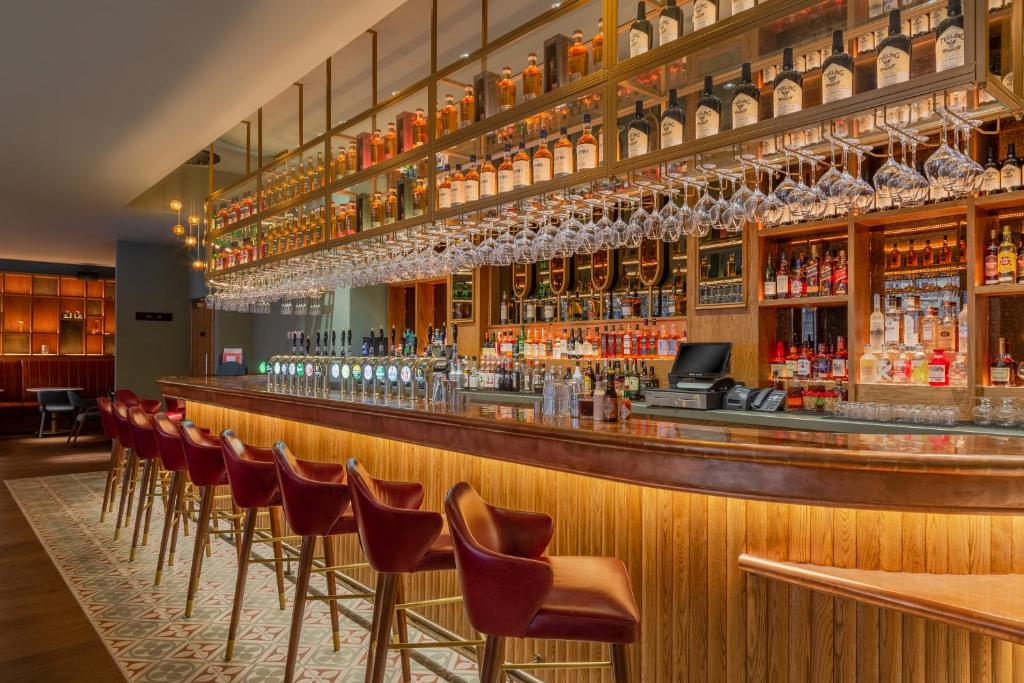
Hotel amenities: restaurant, bar, buffet / full English/Irish breakfast, fitness center, garden, free Wi-Fi, air conditioning, flat-screen TVs, 24-hour front desk, currency exchange
Nearby pubs / bars: The Fourth Corner, John Fallon’s “The Capstan Bar”, Anti Social Bar Dublin
Nearby cafés: Cathedral Cafe, Two Pups, Liberty Kitchen, Ginger Cafe, Phoenix Cafe
Hotel amenities: restaurant, bar, hydrotherapy pool, sauna, steam room, fitness center, city views, free Wi-Fi, air conditioning, flat-screen TVs, coffee machines, ice station
Hotel amenities: bar, restaurant, continental, Full English/Irish or vegetarian breakfast, free Wi-Fi, air conditioning, flat-screen TVs, coffee machines, safety deposit boxes, desks, 24-hour front desk
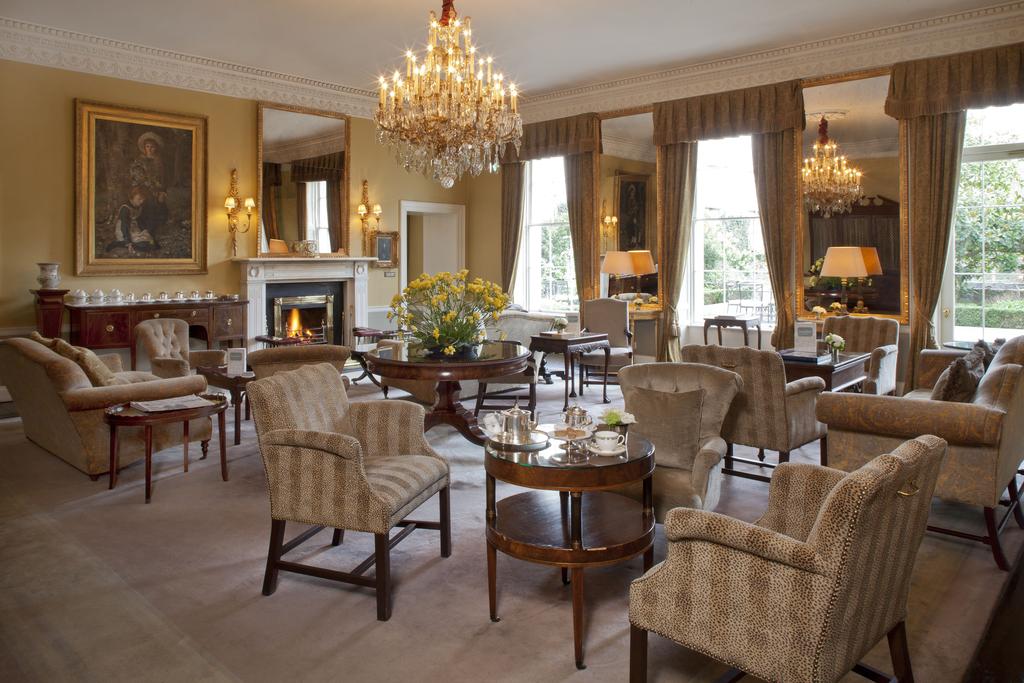
Hotel amenities: award-winning restaurant, bar, lounge, ancient architecture, free Wi-Fi, air conditioning, LCD satellite TVs, luxurious bedrooms, pillow-top mattresses, 24-hour room service menu
Nearby misc.: Clontarf Promenade (park), Dollymount, Wooden Bridge, Crow’s Nest, Dollymount (hiking area), Dollymount Strand (beach), Old St John the Baptist Church, Nolan’s (supermarket), Harry Byrnes (Irish pub), Grainger’s Pebble Beach (pub), Brams Cafe, Happy Out (café), Veda Beauty & Holistic Spa, West Wood Club (gym), Clontarf Lawn Tennis Club, Dublin City Motocross Track, Royal Dublin Golf Club
Guest house amenities: freshly prepared breakfast, sunken guest lounge with leather seating and an open fire, Dyson cooling fans, VOYA Irish toiletries
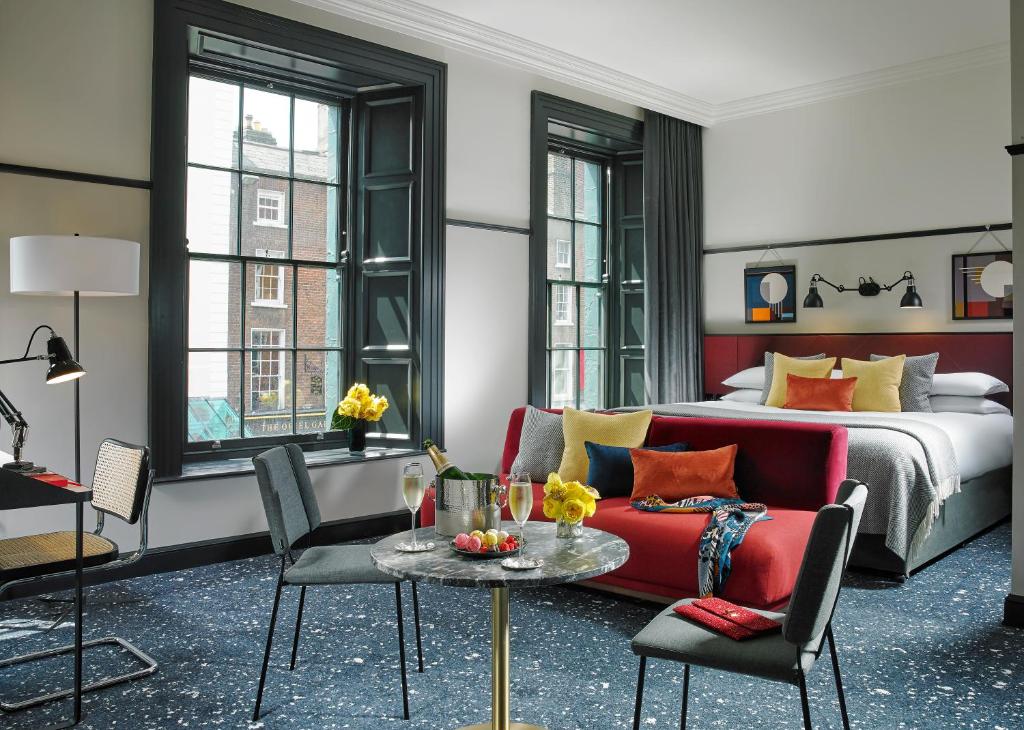
Hotel amenities: Victorian features, free Wi-Fi, Smart TVs, coffee machines, desks, lounge with a computer, traditional Irish and continental breakfast for a charge, limited parking space
Nearby misc.: Grand Canal Dock (park), Escape Boats (escape room center), Bord Gáis Energy Theatre (performing arts theater), Red Sticks Dublin (event venue), Grand Canal Square (event venue), The Lir Academy (drama school), The Art of Coffee (coffee shop), Carved (café), Il Valentino Bakery & Cafe (bakery)
Hotel amenities: buffet, continental or full English/Irish breakfast, garden, free Wi-Fi, flat-screen TVs, kitchenettes, coffee machines, kettles, 24-hour front desk, elevator, facilities for disabled guests
Hotel amenities: full Irish breakfast, garden leading to the Victorian Iveagh Gardens, garden / park views, free Wi-Fi, hairdryers, TVs, free tea / coffee
Hotel amenities: restaurant, award-winning gastro bar, deli, continental, à la carte or Full Irish breakfast options, Smart TVs, coffee machines, rainforest showers, premium toiletries
Approximate cost per night (One-Bedroom Apartment): $474
Cost per person (four people): $118
So there they are, Dublin accommodations that will help make for an outstanding experience. We hope you have found this information valuable and most importantly, that you enjoy your time in Ireland!
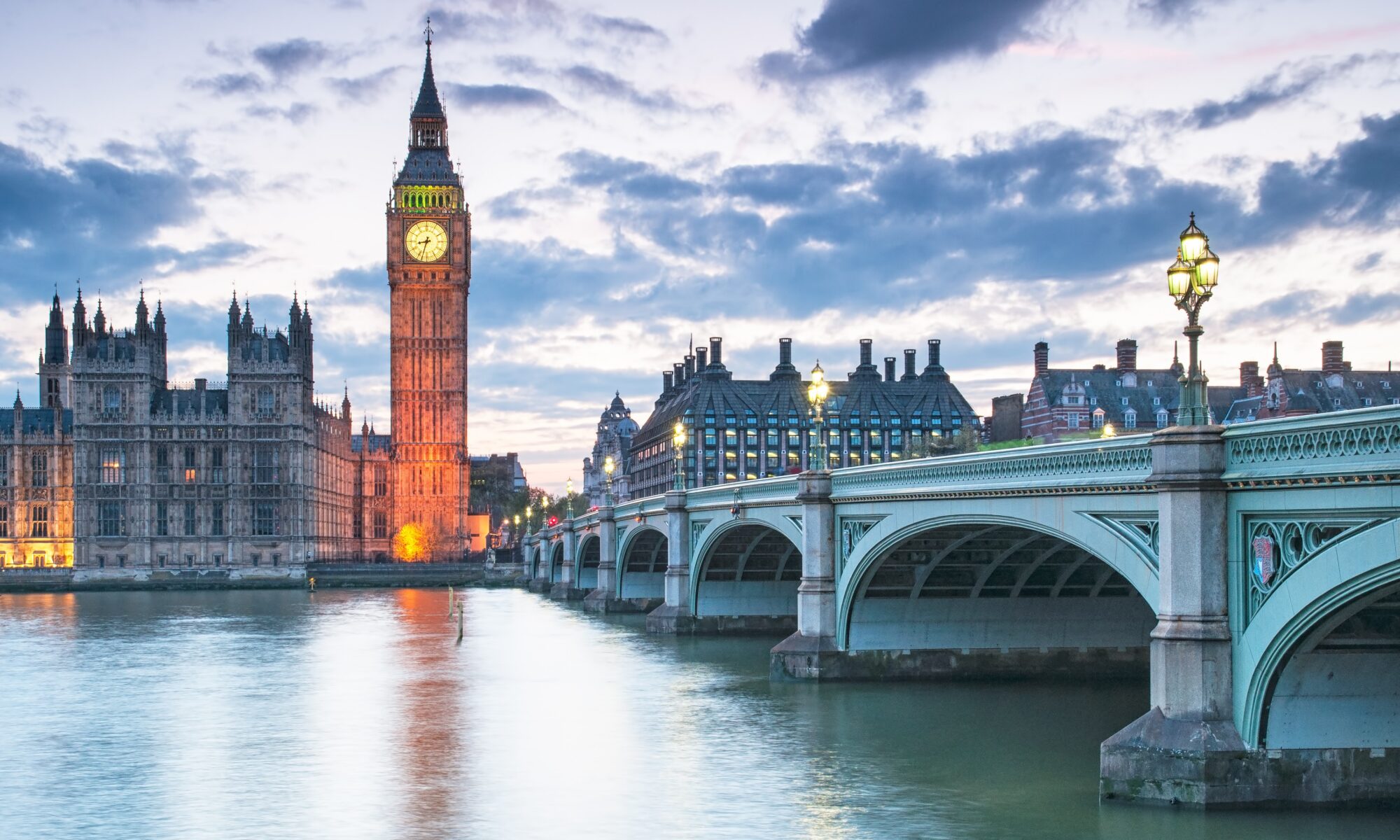
London accommodations invite you to a destination nicknamed “The Big Smoke”. Known for its iconic clocktower & bridge, palaces, towers, country houses, churches, abbeys, museums, art galleries, theaters, concert halls, event venues, markets, shopping areas, parks, gardens, ancient forests, squares, bridges, stadiums / arenas, golf courses, tea houses, pubs, red buses and black cabs, the Greater London area is located in southeastern England, about 120 miles southeast of Birmingham and 80 miles northwest of Dover. The Greater London area spans 611 square miles. Flowing through London, the 215-mile long River Thames (England’s longest river) rises in Gloucestershire’s Cotswold Hills at Thames Head and empties into the North Sea.
When driving, try to stay out of yellow boxes (road markings – yellow crisscross grid of diagonal lines painted on the road surface) as well as bus lanes (may result in fine(s)). Honking is known to occur at yellow boxes, though in this case it’s better to be more mindful of the boxes than of the honkers. London cyclists & pedestrians are famously not shy of vehicular traffic, so always be extra alert when driving in the city.
Rapid transit system:London Underground (world’s oldest subway system – aka “the Underground” / “the Tube”)
Linking passengers from the UK to mainland Europe, Eurostar and High Speed 1 high-speed trains pass beneath the English Channel (Channel Tunnel).
London is home to multiple professional football clubs. Winners of 13 English Football Championships, 14 FA Cups and 17 FA Community Shields, Arsenal F.C. plays at Emirates Stadium on the city’s north side. Not far behind in success, Chelsea F.C., which plays at Stamford Bridge in South West London’s upscale Fulham neighborhood, has won 6 English Championships, 8 FA Cups, 5 EFL Cups and 2 UEFA Champions League titles. Additional London professional football clubs are Tottenham Hotspur F.C., West Ham United F.C. (London Stadium), Crystal Palace F.C. and Fulham F.C.. Good to know in London is that places such as Oxford Street and Leicester Square can get crowded at times. Most museums are free and are least-busy on weekdays or nights. At least a day or two of exploring on foot is advisable, so it might be best to pack sneakers. Also recommended at least once is a ride on the second deck of a bus through your favorite spot. A good navigational app to use in London is citymapper. On underground subway escalators, make sure to stand to the right. London currency is the British Pound, cars travel on the left-hand side and the drinking age is 18 years old. A tourist might spend about £150 per day in London on average. London accommodations are some of the United Kingdom’s best. Before we get to London accommodations, let’s take a look at some more background information on the area to help you along the way.
Discovered upstream from Vauxhall Bridge in 1993, timber from a Bronze Age bridge has been radiocarbon dated to somewhere between 1750–1285 BC. Meanwhile, downstream from Vauxhill Bridge, the foundation of a large timber structure dating to 4800-4500 BC was unearthed in 2010. Roman London became the area’s first major settlement in 47 AD following a Roman invasion four years prior. In 61 AD, Queen Boudica of the Iceni tribe stormed the Roman settlement and razed it to the ground. However, the Roman’s retook and rebuilt the area, with Londinium becoming the Roman province of Britannia’s principal city by 100 AD. Roman rule collapsed in the early 5th century, when the walled city of Londinium became abandoned. Known as Lundenwic, an Anglo-Saxon settlement developed just west of the old Roman city around 500 AD. Viking attacks, beginning in 851 AD, brought decline in what had again become a relatively major port. Around this time, London fell under Danelaw. Laws of the Danes presided, with the Danish warlord Guthrum ruling over East Angles from London to Chester. Danelaw was agreed upon between Guthrum and the West Saxon king Alfred the Great. Alfred retook London from the Vikings circa 886, as recorded by the Anglo-Saxon Chronicle. This “rebuilding” of Londinium saw to Lundenwic’s abandonment, and the revival of life and trade within the old Roman walls. Westminster Abbey was founded in 959 AD as a monastery dedicated to Saint Peter. William the Conquerer, in 1066 after winning the Battle of Hastings, was crowned King of England. Thereafter, William went on to build the Tower of London. In the mid-14th century, The Black Death brought carnage to nearly a third of the city. The 1361 Peasants’ Revolt resulted in the sacking of the Tower of London, mass execution of royal officials, charters being granted to rebel towns, and a subsequent rebel suppression / execution of rebel leaders. Prior to being expelled by Edward I (Edward Longshanks) in 1290, England’s Jewish population had been centered in London. A gradual shift to Protestantism occurred during the Tudor “Reformation” period, at which time much of London property passed from church to private ownership. With The Royal Exchange‘s founding in the 16th century, monopoly traders such as the East India Company expanded trade to the New World. In 1599 during the period of English Renaissance theatre, Richard and Cuthbert Burbage built the Globe Theatre, in which the Lord Chamberlain’s Men were rehoused, and William Shakespeare wrote many of his most famous plays. The 5th of November, 1605 Gunpowder Plot was an unsuccessful regicide attempt against King James I by a group of English Catholics, including the popularized Guy Fawkes. Eight plotters were sentenced to hanging and drawn and quartering. Beginning in August 1642, the English Civil War between Parliamentarians and Royalists resulted in a Parliamentarian victory, the execution of Charles I and the establishment of the Commonwealth of England. Tragic events occurred during the 17th century by way of the Great Plague and Great Fire of London. The Bow Street Runners, London’s first professional police force, was established in 1750 to fight rampant crime. Starting with George II in 1762, Buckingham House grew over the next 75 years into Buckingham Palace. In the early-19th century, Fleet Street became a center of the British press, around which time the Royal Navy became the world’s leading war fleet. Urbanization occurred during the Industrial Revolution. Teashops were founded on “High Streets” during the early-20th century. During the First and Second World Wars, London was bombed by the Germans via Blitzkriegs, or “lightning war”. Wembley Stadium hosted the 1948 Olympics. From the 1970s into the 1990s, bomb attacks occurred in London as a consequence of The Troubles in Northern Ireland.
The United Kingdom’s capital and largest city, London today is home to nearly 9 million “Londoners”. London’s most affluent neighborhoods include Kensington and Chelsea. The West End is a place to find entertainment and shopping areas. London boasts multiple Christmas markets at locations to include Hyde Park, Covent Garden and Southbank Centre. 42 of the city’s skyscrapers exceed 492 feet in height, with The Shard rising highest at 1,016 feet. A top European destination, London operates one of the world’s busiest airport systems. Heathrow Airport alone handles around 84 million passengers annually, while The Big Smoke itself accommodates around 20 million people per year. Over 300 languages are spoken in London. Defined by a temperate oceanic climate, London experiences warm / hot summers and cool winters. July summer high temperatures average around 75 °F, while January winter highs average about 46 °F. Rain falls roughly 33% of the year, with October typically being the rainiest month. Although heavy snow is rare, snowfall does occur during winter. Additional points of interest include Piccadilly Circus (road junction / public space – digital billboards, theaters, restaurants, shopping), St Margaret’s Westminster, Canary Wharf, London Stock Exchange, London St Pancras International, Victoria Coach Station, University of London, Imperial College London, London School of Economics, King’s College London, Royal Central School of Speech and Drama, Royal Observatory, Greenwich, Harrods, Sherlock Holmes Museum, Odeon Cinema and Abbey Road Studios. Local foods include fish and chips, bangers and mash, English breakfast, Sunday roast, chicken tikka masala, roast duck, scones, crumpets and sticky puddling. Popular drinks are gin and tonic, beer and tea. With some background information on the area, we’re ready for London accommodations that will help make for an unforgettable experience.
Nearby misc.:Italian Gardens (garden), Edward Jenner Memorial (historical landmark), Red Telephone Boxes (historical landmark), Buckhill Lodge (historical landmark), AK Films (film production company), Privilege Entertainment Ltd (entertainment agency)
Hotel amenities:bar,free Wi-Fi, flat-screen TVs,kitchenettes, coffee machines, kettles, buffet / continental breakfast, 24-hour front desk, private parking for an extra charge
Nearby sculptures / statues: Mary Poppins Statue, Statue of William Shakespeare, Paddington Bear Statue, Charlie Chaplin Statue, Gene Kelly Statue, Mr. Bean Statue
Hotel amenities:restaurant,bar,fitness center, air conditioning, free Wi-Fi,flat-screen TVs, fully-equipped kitchenettes, coffee machines, kettles,hairdryers, buffet, continental or full English/Irish breakfast, 24-hour front desk, bicycle rental service,facilities for disabled guests
Nearby misc.:Crosby & Hope (deli), Sam Wanamaker Playhouse (performing arts theater), Rose Theatre Trust (performing arts theater), Shakespeare’s Globe Education and Rehearsal Studios (rehearsal studio), The Ferryman’s Seat (historical landmark), NEJA’s Art Walks (tour agency)
multiple restaurants and an award-winning bar, free WiFi, a spa, a health club, a 16-yard swimming pool, a sauna, a steam room, a gym, treatment rooms, air conditioning, flat-screen TVs,
Hotel amenities:restaurant,bar, buffet / Full English breakfast, city views,air conditioning,free Wi-Fi, flat-screen TVs, kettles, desks,hairdryers, 24-hour front desk
Hotel amenities:multiple dining options,380-year-old wine cellar,afternoon tea by the fire,gym,traditional style, modern features,free Wi-Fi, flat-screen TVs, Bose Wave CD players,Nespresso coffee machines,luxury bathroom amenities, award-winning concierge service
Hotel amenities: 2 restaurants (including a Michelin-starred), bar & lounge, spa, fitness center, 24-hour in-room dining, city views, flat-screen TVs, iPads,marble bathrooms
Hotel amenities:restaurant, resistance pool, spa,fitness center, antique furnishings,modern technology, air conditioning, flat-screen TVs, desks, mini-bars, hairdryers, complimentary treats,fresh flowers, fine fabrics, 24-hour front desk
Nearby misc.:Guerlain Spa at Raffles London (spa and health club), ESPA Life at Corinthia (day spa), One Whitehall Place (wedding venue), Great Scotland Yard (notable street), The Civil Service Club (club), Old War Office Building (Churchill’s WWII headquarters), Whitehall Gardens (park), Trafalgar Theatre (performing arts theater), The Gurkha Soldier Statue (monument)
Hotel amenities: restaurant, bar, city views, spa, sauna, fitness center, elegant designs, free Wi-Fi, mini-bars, desks, contemporary bathrooms, bathrobes, hairdryers
Hotel amenities: restaurant, bar, garden views, spa, sauna, steam room, fitness center, art deco style, original artwork, antiques, free Wi-Fi, luxury bathrooms with black and white marble heated floors
Hotel amenities:restaurant, bar,spa, fitness center,park views,19th-century style, modern amenities,air conditioning, free Wi-Fi, in-room tablets, tea / coffee making facilities, daily wake-up service, personal butler service
Nearby restaurants / bars / pubs:Muse by Tom Aikens (fine dining restaurant), Céleste (modern European restaurant), Ametsa (Basque restaurant), Library Bar (cocktail bar), Horse & Groom (pub)
Hotel amenities: Michelin-starred restaurant (award-winning ), spa, fitness center, luxurious fabrics, free Wi-Fi, fine Italian marble bathrooms, afternoon tea
Michelin-starred dining, a spa, 2 bars, butler and concierge services, mood lighting, 32-inch plasma TVs, original artwork and marble bathrooms with plasma TVs and walk-in showers,
Jean-Georges at The Connaught (restaurant), Connaught Bar (bar), The Connaught Pâtisserie, Pragnell (jewelry store), Sergio Rossi (shoe store), Christian Louboutin (shoe store), Scott’s (seafood restaurant), George (social club), Ninety Watches & Jewellery, Mount St (notable street), J & M Davidson, Sautter Cigars, Gianvito Rossi (boutique), MOYNAT (leather goods store), Stefano Ricci (clothing store), MASSIMODECARLO (art gallery), Pash (antique store), Mayfair Gallery (antique store), Majestic Wine (wine store), Jenny Packham London (clothing store), Hamiltons Gallery (art gallery), Roland Mouret (clothing store), Jessica McCormack (jewelry designer), Marchesi 1824 (pastry shop), Delfino Mayfair (pizza restaurant), Jamavar (Indian restaurant), Catholic Church of the Immaculate Conception, Harry’s Bar (club), Mount Street Gardens (park), 34 Mayfair (fine dining restaurant) and more.
Within feet:
Grosvenor Square
Cathedral Church of the Holy Family in Exile
Savile Row
Hamleys Toy Store
Oxford Circus Tube Station
Within 1.3 miles:
Big Ben
Within 3.2 miles:
Tower of London
Within 6.6 miles:
O2 Arena
The Connaught is 11 miles from London Heathrow Airport.
Nearby:Dial Arch (pub), The Taproom (pub), The Friends Cafe, artFix Woolwich (coffee shop), Royal Arsenal Farmers’ Market, Iceland Foods (grocery store), Wing Lee Chinese Takeaway, Maribor Park
Hotel amenities:bar,terrace, air conditioning,free Wi-Fi, flat-screen TVs,coffee machines,mini-bars,desks, safety deposit boxes, à la carte, continental or Full English/Irish breakfast, concierge service,bicycle rental service,shuttle service
Hotel amenities:restaurant, bar, buffet, à la carte or continental breakfast, city views, indoor pool, sauna, air conditioning, free Wi-Fi, flat-screen TVs, coffee machines, mini-bars, safety deposit boxes, Arabic, Mandarin, Danish and German-speaking front desk staff, private parking for an extra charge
So there they are, London accommodations that will help make for an unforgettable experience. We hope you have found this information valuable and most of all, that you enjoy your time in England!
Paris accommodations invite you to a destination nicknamed “City of Lights”. Known for its iconic tower & arch, palaces, castles, museums, theaters, art galleries, event venues, churches, chapels, plazas, squares, sculptures, monuments, parks, gardens, fountains, bridges, markets, bistros, cafes, triangular-shaped streets and fashion, Paris is located in north-central France. Flowing through city-center, the 483-mile long Seine River rises at Source-Seine and ultimately converges at the Paris Basin. Paris’ border is defined by Boulevard Périphérique, a 21.77-mile long ring road encircling the city.
Paris main attractions:Eiffel Tower (iconic Gustava Eiffel tower – wrought-iron, steps, elevators, observation decks, built 1889), Louvre Museum (art museum / former palace – home of da Vinci’s “Mona Lisa”), Arc de Triomphe (iconic triumphal arch to commemorate Napoleon’s victories – observation deck), Champ de Mars (Eiffel Tower park), JJardins du Trocadéro (park – sculptures, central fountain, est. 1937), Jardin du Luxembourg (17th-century park – Medici Fountain, gardens, patterned trees, pedestal statues), Tuileries Garden (expansive 17th-century garden – statues), Musée d’Orsay (19th-20th-century European art museum / former railway station), Notre-Dame Cathedral of Paris (12th-century cathedral – flying buttresses, gargoyles), La Villette (urban park – wide lawns, museum, cinema, music complex, sculptures, fountains), Place de la Concorde (plaza – fountains, statues, Egyptian obelisk, scene of executions), Panthéon (18th-century mausoleum – colonnaded façade, notable French citizens tomb), Palais Garnier (Italian-style opera house), Jardin des Plantes (botanical garden / restored 19th-century hothouses), Sainte-Chapelle (13th-century Gothic chapel – relics, stained-glass windows), Pont Alexandre III (19th-century arched bridge – ornate Beaux Arts style, named after Russian czar), Accor Arena (pyramid-shaped event venue), Parc des Princes (PSG stadium), Atelier des Lumières (immersive art center), Place des Vosges (city’s oldest square – tree / red brick house-lined, built by Henri IV c. 1612), Bateaux-Mouches (boat tour agency – classic restaurant aboard a barge, Seine / Eiffel Tower views), Parc des Buttes-Chaumont (19th-century park – lake, waterfalls, tall trees, old iron railway bridge), Grand Palais (art nouveau hall / museum – domed-glass roof, exhibitions, events, built 1900), Fondation Louis Vuitton (art museum – auditorium, roof terraces), Petit Palais (fine art museum – Renaissance-20th century), Parc Monceau (park – trees, tarmac trails, statues, 18th-century colonnade, pyramid follies), Musée de l’Orangerie (art museum – home of 8 Monet water lilies murals), Musée Rodin (18th-century mansion / sculpture garden – Rodin’s “The Thinker”), Pont Neuf (1607 arched stone bridge – 2 spans, King Henri IV equine statue), Domaine National du Palais-Royal (palace – 17th-century arcades, gardens, courtyard columns), Musée du quai Branly – Jacques Chirac (world art museum), Ober Mamma (Italian restaurant), Stellar by Ephemera (restaurant), Pont des Arts (picturesque bridge over the Seins – connects the Louvre & the Institut de France), Parc Montsouris (Napolean III-founded park – London-inspired), Montparnasse Tower (modern tower – roof terrace, 56th-floor observation deck, Eiffel Tower / panoramic views), L’Olympia (19th-century concert hall – live music, comedy), La Madeleine (church / concert venue – est. 1842 in honor of Napoleon’s armies), Théâtre Mogador (performing arts theater), Place du Trocadero (paved plaza – military monument, Eiffel Tower views), Carnavalet Museum (art museum / history exhibits- 16th-17th centuries), The Dome of Paris (domed indoor arena / live music venue – music, theater, dance), Musée Marmottan Monet (Monet / impressionist art museum), Musée des Arts et Métiers (science & industry museum / converted church – artworks, artifacts, Foucault’s pendulum), Roland Garros Stadium (French Open site / tennis courts – built 1928), Jardin du Palais Royal (17th-century palace landscaped grounds – tree-lined walkways, flowerbeds, large fountain), Musée Jacquemart-André (Art museum . 19th-century townhouse – 15th-18th- century works), Musée des Arts Décoratifs (art museum – ornate ceramics, crystal, fine furniture, Middle Ages-present day), Musée d’Art Moderne de Paris (modern art museum), ANDIA (Latin-American restaurant), Musée Guimet (Asian art museum), Au P’tit Grec (creperie), National Museum of Natural History, Cluny Museum – National Museum of the Middle Ages, The Centquatre-Paris (former factory / cultural center – dance classes, concerts, exhibitions), Paris Philharmonic (concert hall), Galerie de Paléontologie et d’Anatomie comparée (natural history museum), Via Del Gusto (traditional Italian restaurant), Bataclan (live music venue), La Galerie Dior (scenography fashion museum), Hôtel de la Marine (heritage museum), MELT Cambronne (barbecue restaurant), Musée de Montmartre (art museum / 17th-century house – garden where Renoir once worked), Théâtre du Palais-Royal (performing arts theater), Bourdelle Museum (Antoine Bourdelle art museum – studio, garden), Église Saint-Augustin (19th-century Roman Catholic church), New Morning (live music venue), Théâtre des Béliers parisiens (performing arts theater), Jardin Catherine-Labouré (landscaped garden – lawn, ornamental vines, playground), LA SCENE BARBES – Comedy Club Pararden
Bordering Parispoints of interest (near Boulevard Peripherique):Stade de France (stadium), Bois de Vincennes (995-hectare park – lakes, hiking / biking trails, botanical garden, zoo. horse racecourse), Château de Vincennes (14th-century castle – moat, towers, pavilion, state rooms, guided tours), Parc Floral de Paris (floral garden – 3,000 or so plant species, artificial lake, pavilions, summer concerts), La Seine Musicale (egg-shaped music & dance venue), Saint-Cloud National Estate (vast parkland / Marie Antoinette’s rose garden), NIKITO Alfortville (amusement center), Ile Saint-Germain Park (island park – gardens, sculptures, recreation areas, ponies), Château de Malmaison (former Napoleon & Josephine country home – 19th- century décor, furnishings & paintings), Malmaison Forest (200-hectare national forest – pond, hiking, biking, interpretive trail), Château de Sceaux (19th-century castle / art & ceramics museum – formal gardens, fountains), Le Kilowatt (performing arts venue)
When driving, keep in mind that drivers must yield to vehicles approaching from the right at intersections.
Winners of 13 Ligue 1 titles, 16 Coupe de France, 9 Coupe de la Ligue and 13 Trophée des Champions, Paris Saint-Germain FC (PSG) plays at Le Parc des Princes (about 2 miles southwest of the Eiffel Tower). When in Paris, guests should always start a question with bonjour madame / monsieur. Although basic English is widely understood in tourist areas, learning some French phrases beforehand of course would be helpful. English comprehension drops noticeably outside of tourist areas. Public bathrooms are relatively sparse, and may be found only at cafés or bars in places. At many metro stations, WiFi is free for 20 minutes. While eating in public, one should avoid using a smartphone or handling documents. Dressing up will help one blend in. Once common on Parisian walkways, mimes have largely gone extinct. Paris currency is the Euro, cars travel on the right-hand side and the drinking age is 18 years old. Paris accommodations are some of France’s best. Before we get to Paris accommodations, let’s take a look at some more background information on the area to help you along the way.
First inhabited by the Gallic Parisii tribe, Paris has been occupied since the 3rd century BC. The Parisii traded with other river towns and even minted their own coins. An important trading center around this time, île de la Cité (island) anchored Paris. The Romans conquered the Paris Basin circa 52 BC and settled on Paris’s Left Bank. Originally known as Lutetia, the Roman settlement expanded to include an amphitheater, a forum, baths, theaters and temples. The area became known as Parisius (Latin for Paris) in the 3rd century AD, a period in which Paris’s first Bishop, Saint Denis, introduced Christianity. Unfortunately for Saint Denis the Romans had not yet adopted the Christian faith. Refusing to renounce his faith, Saint Denis was martyred by way of beheading. Saint Denis was beheaded on what would become known as the “Hill of Martyrs” (present-day Montmartre). Legend has it that a headless Saint Denis walked northward to his final falling place, a spot that would become the Basilica of Saint-Denis, in which many French kings would later be buried. In 508, Clovis the Frank, king of the Merovingian dynasty, made Paris his capital after a multi-year Roman resistance therein. Clovis I would become the first Frankish king to unite all the Frank tribes under one ruler. Franks gradually migrated to Paris and a Parisian-Francien dialect evolved. Vikings sieged Paris several times between 845-886. The Vikings looted the city and enforced bribes. Viking sieges were finally assuaged after the 885 Siege of Paris. The Vikings were suppressed largely by two fortified bridges that had been built near Île de la Cité, which prevented Viking ships from passing. The Palais de la Cité became the city’s focal point during the 12th century. In 1163, Louis VII and Bishop Maurice de Sully constructed Notre Dame Cathedral. Built in 1190 by King Philip II to protect against English invasions from the west, the Louvre fortress would eventually become the Louvre Museum site. Europe’s most populous city, Paris was inhabited by around 200,000 people in 1328. England took control of the city for a brief period following the Hundred Years’ War. During the French Wars of Religion (1562-1598), the 1572 St. Bartholomew’s Day Massacre saw the Catholic League massacre thousands of French Protestants. France remained Catholic following the religious wars, albeit with tolerance for Protestantism. Determined to make Paris Europe’s most beautiful city, Cardinal Richelieu, Louis XIII’s chief minister, built five new bridges, a new chapel for the College of Sorbonne and the Palais-Royal during the 17th century. Louis XIV, during his 72-year reign, commissioned the Palace of Versailles and replaced the city walls with tree-lined boulevards. Versailles Palace had begun as a small hunting lodge built by Louis XIII. Paris’ population grew to around 650,000 by 1780. Around this time, Champs-Élysées avenue was commissioned by Louis XIV and designed by landscape architect André Le Nôtre. Centered in Paris, the Age of Enlightenment lasted until 1789. The 1789 French Revolutionincluded the Reign of Terror and executions of Louis XVI and Marie Antoinette. Thereafter a constitutional monarchy was created and the first republic formed in September 1789. The French Revolutionary Wars saw Napoleon Bonaparte arise victorious. Napoleon established the First French Republic and subsequent First French Empire., with Paris serving as his headquarters. Following Napoleon’s defeat at the Battle of Leipzig, he was exiled by the British to the remote, Atlantic island of Saint Helena, where he died in 1821 aged 51. Paris was besieged by the Prussian Army during the 1870 Franco-Prussian War. Germany having won the war, the Second French Empire came to an end, and the German Empire was founded. Paris remained France’s capital throughout the German Empire era. During this time, new fountains, a metal bridge, a railway line, an opera house, a central market, gas lamps, aqueducts and sewers helped modernize the city. In the late-1800s, impressionist painters emerged such as Manet, Monet and Renoir. By the early-20th century, Paris’ population had grown to over 2.7 million people, one of whom was Pablo Picasso. During World War I, German Zeppelins and long-range guns bombarded Paris. As many as 1,000 Parisian taxis transported 6,000 soldiers to the front lines at the WWI First Battle of the Marne. During World War II, Paris was declared an open city, and the German army marched in unopposed on June 14, 1940. On August 25, 1944, the French 2nd Armoured Division, alongside the 4th Infantry Division of the United States Army, liberated Paris from the Nazis. Afterwards, General Charles de Gaulle made an inspirational speech at the Hôtel de Ville. Paris hosted the 1998 World Cup, along with the Summer Olympics in 2024.
France’s capital and most populous city, Paris today is home to over 2 million “Parisians”. Paris’ urban area inside Boulevard Périphérique spans 1,090 square miles. City of Lights has multiple canals to include the Ourcq, Saint-Martin, and Saint-Denis canals. Due to height restrictions, the city’s only true skyscraper is Tour Montparnasse at 690 feet. In comparison, the Eiffel Tower stands at 1,083 feet. Naturally, tourism is a key economic contributor. Nearly 49 million people visited Paris in 2024. In 2023, the Louvre Museum received around 9 million visitors. Once home to Christian Dior, Gabrielle “Coco” Chanel and Yves Saint Laurent, Paris is of course a fashion epicenter. Paris Fashion Week is held at various venues to include The Grand Palais, The Carrousel du Louvre and The Rodin Museum. Paris’ secondary airport is Orly Airport. Home to an oceanic climate, Paris experiences warm summers and mild winters. Summer July high temperatures average around 78 °F, while January winters stay around 46 °F. Light night frosts / snow flurries are common during winter. Additional points of interest include Musée Picasso, Pompidou Centre, Élysée Palace, Hôtel de Sens, Comédie Française, Sainte-Geneviève Library, Gare du Nord, Sorbonne University, Avenue des Champs-Élysées, Rue de Rivoli, Place de la République, Place des Vosges, Place de la Bastille, Parc des Buttes-Chaumont, Paris Catacombs, Hôtel-Dieu de Paris and Front de Seine. Local foods include steak tartare, duck confit, oysters, squab (young pigeon), escargot, frog legs, coq au vin (chicken braised with wine), couscous, cheese, steak frites, croissants, baguettes, macarons, eclairs and chocolate. Popular drinks are wine, beer, apéritifs, absinthe, pastis (licorice-flavored spirit), calvados (apple brandy) and espresso. With some background information on the area, we’re ready for Paris accommodations that will help make for an incredible experience.
Hotel amenities:restaurant,bar,indoor pool, fitness center, sauna, terrace,free Wi-Fi, flat-screen TVs, coffee machines, kitchens, buffet / continental breakfast, 24-hour front desk,concierge service
Hotel amenities:bar,terrace, balconies,air conditioning,free Wi-Fi, flat-screen TVs,desks, coffee machines, electric tea pots,safety deposit boxes, 24-hour front desk,concierge service, business area
Nearby restaurants:Chez Marie, paris 10 (fast food restaurant), Le Martel (couscous restaurant), Dumbo Petites-Écuries (American restaurant), Le daily syrien Bar (Syrian restaurant), Zinga (Caribbean restaurant), Jah Jah By Le Tricycle (vegan restaurant), Flour (fast food restaurant), Cinco Bodega (pizza restaurant)
Nearby misc.: Goku Comedy Club, Le Cham’ Bar, L’Ouvre-Boîte (book store)
Hotel amenities: air conditioning, free Wi-Fi, flat-screen TVs,desks, 24-hour front desk with Arabic, German, English and French-speaking staff, concierge service, luggage storage, buffet, continental or gluten-free breakfast
Nearby restaurants: Kangen Vietfood (Asian restaurant), Rūlo Hand Roll (sushi restaurant), Poco Loco (restaurant), Le bistrot (brasserie), HOMADE (brunch restaurant), Sezono (vegetarian restaurant)
Hotel amenities:bar,free Wi-Fi, flat-screen TVs, hairdryers, 24-hour front desk
Nearby restaurants / bars: WOW TIBET (restaurant), Kokonor (Tibetan restaurant), La muraille du Phenix (Asian restaurant), An An Restaurant Vietnamien (Vietnamese restaurant), Au Vieux Cèdre (Lebanese restaurant), Le Coup de Torchon (French restaurant), Yi One (Mandarin restaurant), Casa Di Peppe (Italian restaurant), Ozumaki Luxembourg (restaurant), Le Pantalon (bar), The Crocodile (cocktail bar)
Nearby misc.:Skin Chic (beauty salon), La Maison Des Sons (music school), Emablues – Showroom : Réservé aux professionnels (women’s clothing store), Swapfiets Paris (bicycle rental service), Make and Mark (store), Au Charbon | Salle À Louer (function room facility)
Nearby restaurants / bars:Afaria (French restaurant), La Seranata Paris (Italian restaurant), Restaurant Villa Positano Porte de Versailles Convention (Italian restaurant), Chiang Rai Mai (Thai restaurant), The Counter Rugby Bar (sports bar), Les canailles Vaugirard (cocktail bar)
Nearby misc.: Crêperie Ty Fanch (creperie), Malt in Stock (wine store)
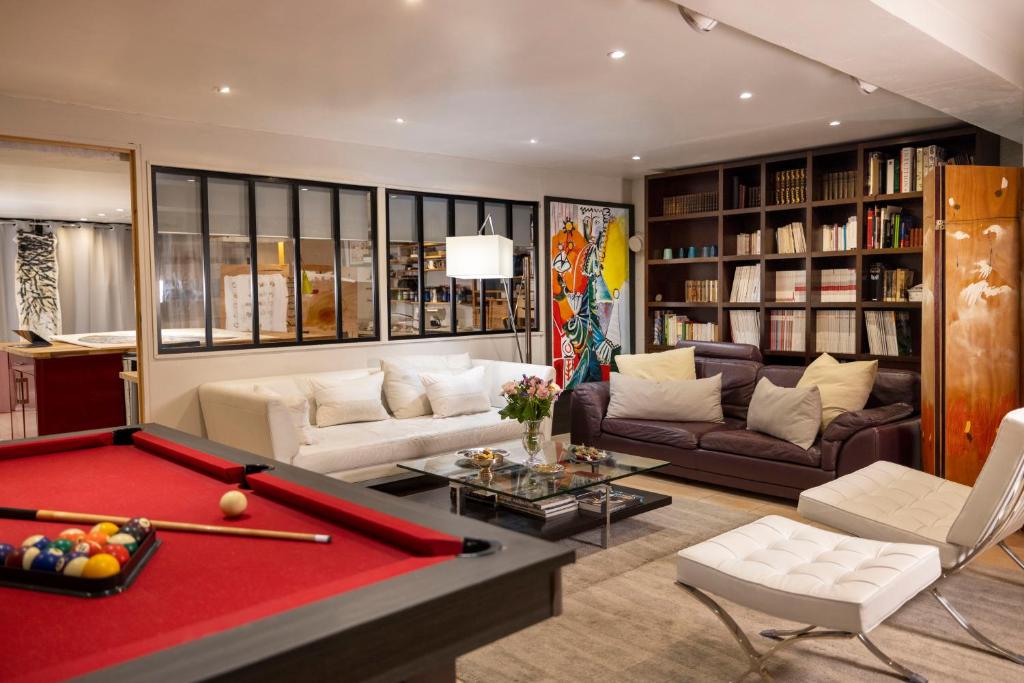
Hotel amenities:restaurant, indoor pool, spa, sauna, hot tub, wellness center, fitness center, air conditioning,,free Wi-Fi, flat-screen TVs, safety deposit boxes, kitchenettes,coffee machines, buffet breakfast, pool tables, hammam, 24-hour front desk, business center
Nearby restaurants:Restaurant l’Envolée (French restaurant), L’Estel (brasserie), Maître Pierre (Italian restaurant), Via Pasta (Italian restaurant) Enni Udon (Japanese restaurant), Samy’s (Lebanese restaurant), Le Relais Plaza (restaurant), Bar des Théâtres (restaurant), Côme Marbeuf (restaurant), Bellota-Bellota® Champs-Elysées (restaurant), Shirvan, Café Métisse (restaurant), Bellota-Bellota Champs-Elysées (restaurant), Côme Marbeuf (salad shop), Les Petits Déjeuners du Plaza Athénée (breakfast restaurant)
Nearby misc.:Le Bar (bar), DIOR (clothing store), Jean-Manuel Moreau (clothing store), Giuseppe Zanotti (shoe store), Thom Browne Paris (fashion designer), Harry Winston (jewelry designer), Salon Antoine B. (hairdresser), Cible Skin (skin care clinic), La Cave Vignon (wine store), La Cave Vignon (wine store), Av. Montaigne (notable street), Place de la Reine Astrid (park), Le 28 George V (event venue)
Within feet:
Square du Palais Galliera (Palais Galliera Square)
Hotel amenities:bar, terrace, patios, city views, garden, sauna, fitness center, air conditioning, free Wi-Fi, flat-screen TVs, safety deposit boxes, hairdryers, coffee machines, buffet, continental or vegetarian breakfast, Arabic, German, English and Spanish-speaking reception staff, ATM, playground, business center
Nearby restaurants: Kochi (Korean restaurant), Kochi (Korean restaurant), Le Tour du Liban (Lebanese restaurant), Chapeau (restaurant)
Nearby restaurants:Le Casse Noix (French restaurant), La’Abreuvoir (Brasserie), Villa Verdi (Italian Restaurant), Le Concert de Cuisine (fusion restaurant), Restaurant de la Tour (restaurant)
Nearby misc.:cc142 (creperie), Salon De Coiffure (hair salon), L’Ongierie (nail salon), Nicolas (wine store), Mas charcuterie (butcher)
Hotel amenities:winter garden, sauna,fitness center, hammam, air conditioning,free Wi-Fi,flat-screen TVs, mini-bars, bathrobes, slippers, American buffet breakfast, 24-hour front desk, private transfer service for a surcharge, tour desk
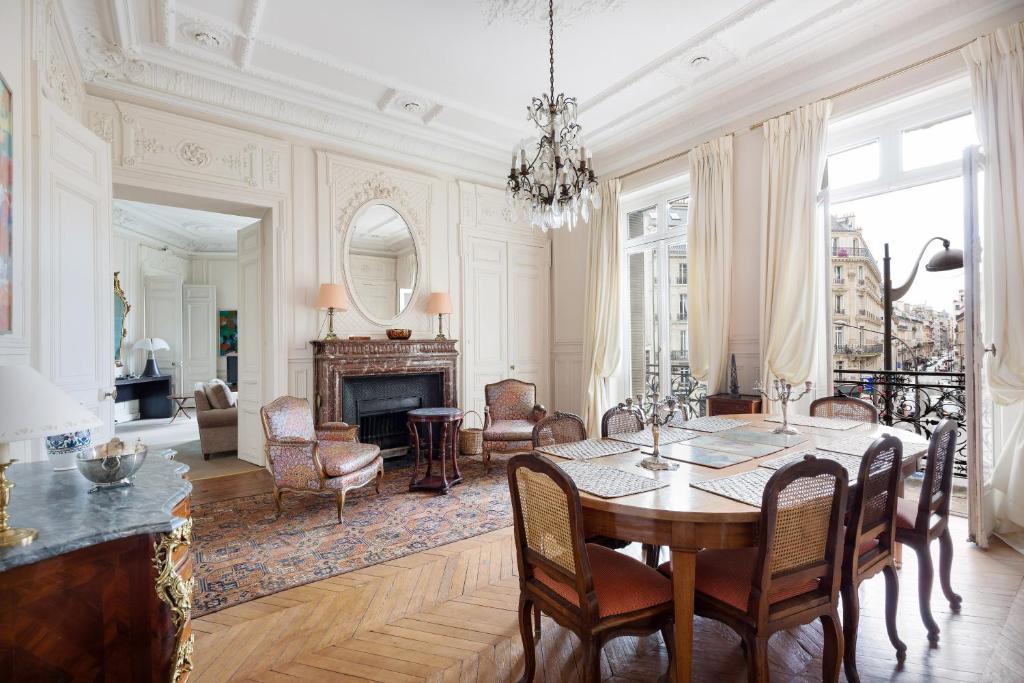
Hotel amenities: jazz bar, interior courtyard with a fountain and marble statues, courtyard views, original beams, antique furniture, monumental fireplaces made of Burgundy stone, four-poster beds, marble bathrooms, Nespresso coffee machines, free Wi-Fi, full English breakfast, elegant breakfast room, 24-hour reception, airport shuttle, massage services upon request, underground parking
Hotel amenities: restaurant, bar, terrace, balconies, city views, air conditioning, free Wi-Fi, coffee machines, desks, concierge service, luggage storage, buffet, à la carte or continental breakfast, Arabic, English, Spanish and French speaking reception staff
Hotel amenities:honesty bar, tea room, air conditioning, free Wi-Fi, flat-screen TVs, hairdryers, wellness center, hammam, massage service for an extra charge
Hotel amenities:champagne bar, buffet breakfast, in-room breakfast service, patio, exposed wooden beams, individually-decorated rooms, free Wi-Fi, flat-screen TVs, tea / coffee making facilities
Nearby restaurants / pubs : Pasta Linea (Italian restaurant), Salento Marais (Italian restaurant), A modo mio (Italian restaurant), La Mangerie (European restaurant),Khao Thai Sévigné (Thai restaurant), Chez Ajia (Taiwanese restaurant), Keko Momo (Chinese restaurant), Joji (Asian restaurant), Les Bougresses (down home cooking), Casa San Pablo (restaurant), Les petites bouchées (restaurant), Clark Hot Dog (fast food restaurant), Magnum Pleasure Store Paris (sundae restaurant), The Auld Alliance (pub)
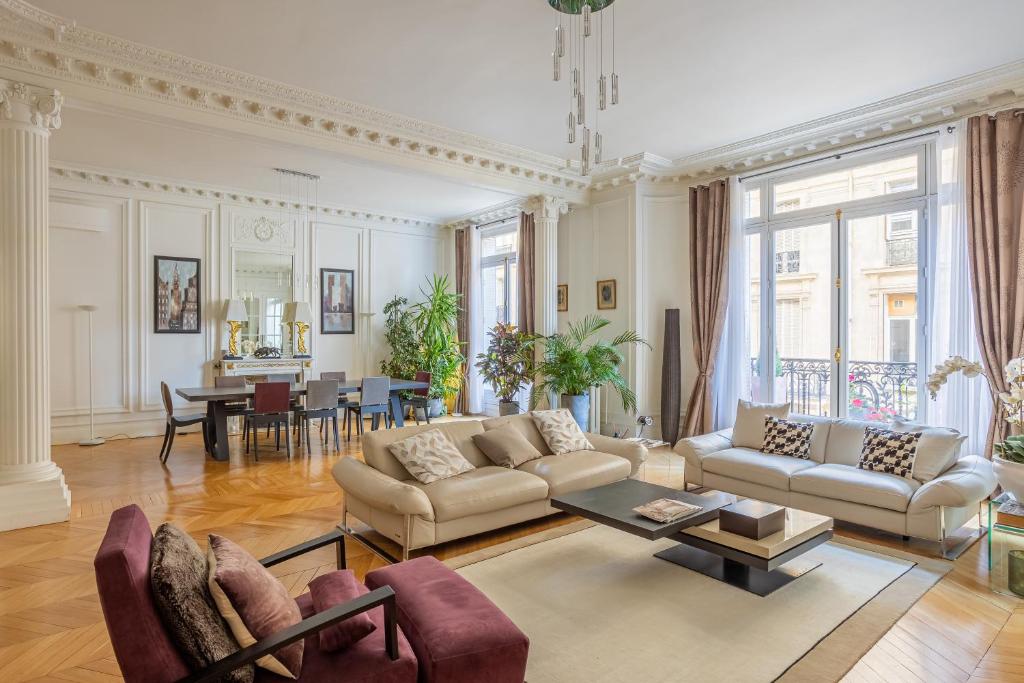
Hotel amenities:river views,fitness center, air conditioning,free Wi-Fi, flat-screen TVs, fully-equipped kitchens, bathrobes, slippers, 24-hour front desk, concierge service
former Prince Roland Bonaparte’s residence & national heritage site
Musee de l’Homme
Hotel amenities: 2 restaurants (including a Michelin-starred), historic billiard room with a fireplace,Eiffel Tower views,indoor pool, fitness center, spa, European Empire / Asian aesthetics, custom-made furniture, crystal finishing,separate living rooms, flat-screen TVs, iPod docking stations, laptop safes, desks, marble bathrooms with heated flooring, Guerlain toiletries, rainfall showers
Hotel amenities:restaurant,bar, terrace, outdoor swimming pool,spa, fitness center, air conditioning,flat-screen TVs,coffee machines,mini-bars, safety deposit boxes,24-hour front desk, luggage storage, continental or à la carte breakfast
Hotel amenities:2 Michelin-starred gastronomic restaurants,garden, courtyard & street views,rooftop swimming pool with Eiffel Tower views, inner French garden, solarium,spa, Louis XV / Louis XVI-style furniture, double washbasins, kids club
Nearby French restaurants:L’Orriu di Beauvau, Le Griffonnier, Le Laurent, Le Boudoir, Epicure, 114 Faubourg
Nearby misc. restaurants / bars: Caffe Bellucci (Italian restaurant), Officina Schenatti (Italian restaurant) Cafe Antonia (restaurant), Bugsy’s(bar & restaurant), Le Bar du Bristol (bar)
Hotel amenities: restaurant, bar, terraces,city views,indoor pool, spa, wellness center, hammam,air conditioning,free Wi-Fi, flat-screen TVs, kettles, desks, continental or à la carte breakfast, 24-hour front desk,concierge service
Hotel amenities:restaurant, bar,terrace, city views,sauna, wellness area, hammam,air conditioning,free Wi-Fi,flat-screen TVs,desks, coffee machines, electric tea pots,mini-bars, safety deposit boxes, continental / American breakfast, 24-hour front desk,evening entertainment
Nearby restaurants / bars:Bistrot Instinct (French restaurant), La Briciola (Italian restaurant), Pizzeria Maria (pizza restaurant), PNY (hamburger restaurant), Little Red Door (cocktail bar)
Hotel amenities:restaurant,bar, buffet,, continental or American breakfast, terrace, city views, indoor pool, hot tub, fitness center, hammam, air conditioning, free Wi-Fi, flat-screen TVs,coffee machines, electric tea pots,mini-bars, safety deposit boxes, 24-hour German, English, Spanish and French-speaking front desk staff, concierge service, private parking for an extra charge
Guest House amenities:sun terrace,city / garden views, spa, sauna, hot tub,fitness center, air conditioning,free Wi-Fi, flat-screen TVs, safety deposit boxes, kitchens, coffee machines, kettles,open-air baths, hairdryers, a la carte / continental breakfast, 24-hour front desk,private parking, indoor play area, outdoor play equipment
Nearby restaurants:IL FARNIENTE (Italian restaurant) Le XIV Eme (Portuguese restaurant), Veni Vici (restaurant)
Nearby misc.: Melody Beauty (hair salon), Le Nombre d’Or (hair salon)
Within feet:
Jardin Marie-Thérèse Auffray
Au Parc Montsouris
Square Alberto Giacometti
Place Denfert-Rochereau
Porte d’Orléans Metro Station
Within 2.3 miles:
Rodin Museum
Within 6 miles:
Orly Airport
Maison Lavaud is 11 miles from Toussus-le-Noble Airport.
Approximate cost per night (Penthouse Apartment): $1,632
Hotel amenities:restaurant, bar, terrace, balconies, city views, garden,air conditioning,free Wi-Fi, flat-screen TVs,coffee machines, electric tea pots,mini-bars, desks,safety deposit boxes, à la carte / vegetarian breakfast, 24-hour front desk
Hotel amenities:bar,terraces,spa center,sauna,fitness center, air conditioning, free Wi-Fi, flat-screen TVs, coffee machines, electric tea pots,mini-bars, desks,safety deposit boxes, buffet, à la carte or continental breakfast, Arabic, English, Spanish and French-speaking reception staff, concierge service
Nearby misc.: Compagnie Française des Poivres et des Epices (deli), Oz Garden (florist), Rue de Furstemberg (notable street), ARTY DANDY (gift shop), Yveline Antiques (antique furniture store)
Nearby misc.: Maison Largesse (bakery), Laiterie Gilbert Paris 14 Alésia (cheese shop), Les Saisonniers – Alésia (grocery store), Tentation (florist), Soleil Nails (nail salon), Retoucherie BleuBlanc (clothing alteration service), Carmen (costume jewelry shop)
Within feet:
Square Alberto Giacometti
Jardin de la Zac Didot
Jardin Françoise Heritier
Jardin du Cloître
Pernety Metro Station
Within 1.5 miles:
Luxembourg Gardens
Within 2.1 miles:
Orsay Museum
Villa Alesia is 10 miles from Toussus-le-Noble Airport.
Approximate cost per night (Five Bedroom Villa): $2,751
Cost per person (ten people): $275
So there they are, Paris accommodations that will help make for an unforgettable experience. We hope you have found this information valuable and most of all, that you enjoy your time in France!
Rio de Janeiro accommodations welcome you to a destination nicknamed “Marvelous City”. Known for its mountaintop statue, crescent beaches, shopping malls, museums, theaters, rainforest trails, parks, peaks, waterfalls, football, Carnival and bossa nova samba music, Rio de Janeiro is located on Brazil’s southeastern coast, about a 6-hour drive northeasterly from São Paulo. The city’s coastline runs east-to-west. Surrounded by natural beauty, Rio is set near Guanabara Bay (immediate east), The Ilhas Cagarras – Cagarras Islands (immediate south) and Tijuca National Park (immediate west). Apart from being a major Brazilian seaside city, Rio de Janeiro is also its own State, or federative unit. Argentina’s border is about 900 miles southwesterly.
Rio main attractions:Christ the Redeemer (iconic, mountaintop Jesus Christ statue – city views, accessed by train), Maracanã (stadium), Museu do Amanhã (waterfront science museum), Escadaria Selarón (iconic stairway – colorful, hand-painted tiles by artist Jorge Selarón), AquaRio (aquarium – 28 enclosures, surf museum, food outlets, gift shop), Barra Shopping (shopping mall), Shopping RioSul (shopping mall), Shopping Tijuca (shopping mall), Parque Lage (park – wooded trails, Christ the Redeemer views, café, old mansion, art school), Botafogo Praia Shopping (shopping mall), Botanical Garden of Rio de Janeiro (historic park – garden trails, diverse flora / fauna, scientific research institute), Copacabana Fort (museum), Centro Cultural Banco do Brasil – CCBB (1906 neoclassical building – art galleries, cinema, theater), Quinta da Boa Vista (municipal park / former royal palaces – zoo, archaeological museum), Via Parque Shopping (shopping mall), Municipal Market RJ – CADEG (warehouse bazaar – restaurants, produce, wine, flowers, plants and more), Shopping Metropolitano Barra (shopping mall), Paineiras Corcovado – Cristo Redentor (Christ the Redeemer lookout spot – cafes, shops), Shopping Leblon (shopping mall), Pedra do Arpoador (rocky peninsula – walking paths, surfing spot, sunset views), Uptown Barra (shopping mall), Parque Brig. Eduardo Gomes – Aterro do Flamengo (expansive city park – restaurants, theaters, modern art museum, beaches, sports fields), Sambadrome Marquês de Sapucaí (Rio Carnival Sambodrome), Catedral Metropolitana de São Sebastião do Rio de Janeiro (modern Catholic cathedral – pyramid-shaped, est. 1979), Estádio São Januário (stadium), Centro Luiz Gonzaga de Tradições Nordestinas (expansive market – restaurants, handicraft stalls), Municipal Theater of Rio de Janeiro (Parisian-style theater – ballet, classical music performances, tours, est. 1909), Tijuca National Park (urban rainforest – hiking, birdwatching, waterfalls, vista points), Rio Museum of Art, Marina da Glória, Estátua de Carlos Drummond de Andrade (Brazilian poet Carlos Drummond de Andrade bronze, waterfront statue – photo spot), Museu Nacional de Belas Artes (fine art museum), Museu de Arte Moderna do Rio de Janeiro (modern art museum), Pedra do Sal (small plaza – samba parties, rustic drink stands), Museu da República – Palácio do Catete (museum / former Republic of Brazil headquarters – art, documents, theater, gardens), VillageMall (shopping mall), Red Beach (small, headland-protected beach – coarse, reddish sand, calm water), Trilha do Morro da Urca (Sugarloaf Mounatin jungle trail), Parque das Ruínas (park / mansion ruins – art gallery, outdoor concerts, café), EXPO MAG (convention center), Cidade das Artes (cultural center – art shows, dance performances, concerts), Área de Proteção Ambiental de Grumarii (nature preserve), Rio Design Barra (shopping mall), ParkJacarepaguá (shopping mall), Parque dos Patins (recreational park – roller skating / skateboarding area, swings, jungle gyms), Mirante Dona Marta (cliffside lookout point – panoramic city / Christ the Redeemer views), Vista Chinesa (observation deck – Chinese-style pavilion, mountain / city / sea views), Parque Eduardo Guinle (wooded park – walking trails, duck pond, picnic areas, playground), Sugarloaf Mountain (iconic mountain – cableway, sweeping views), Copacabana Beach (iconic, 2.2-mile beach – promenade, food kiosks), Espaço Cultural da Marinha (maritime museum), Rio Scenarium (multilevel bar / nightclub), Praia da Barra da Tijuca (expansive, bustling sandy beach – food kiosks, open sea views), Palácio – Parque Lage (park palace – European-style gardens, stone paths / alleys), Parque Olímpico do Rio de Janeiro (sports complex), Museu Histórico Nacional (history museum / former military fort – artifacts), Ipanema Beach (extensive, popular beach – sunbathing, soccer, volleyball), Abricó Beach (spacious nude beach – strong waves, island views), Prainha Beach, Praia da Joatinga (beach), Fada Madrinha (pastry shop), Monumento Nacional aos Mortos da Segunda Guerra Mundial (monument for fallen heroes – sculptures, unknown soldier tomb), João Caetano Theater (Rio de Janeiro’s oldest theater – operas, plays, musicals, est. 1813), Praia da Reserva (sandy beach – surfing, swimming, sunbathing), Curupira Recreio dos Bandeirantes (sandy beach – snack bars, peninsula views), Teatro Riachuelo Rio (19th-century theater – plays, musicals, stand-up comedy, concerts), Mirante do Joá (lookout point – colorful tile mosaics, panoramic beach / ocean views), Bosque da Barra (forested nature preserve – lake, jogging paths, various plant species), Mosteiro de São Bento (1600s church – 18th-century ornate, gilded carvings), Museum of Astronomy and Related Sciences (science museum), Horto Waterfalls (Tijuca National Park waterfalls – cascade, pool, lush tropical foliage), Trilha Pedra do Telégrafo (hiking area), Bosque da Freguesia (dense forest park – paths, fruit trees, colorful birdlife, butterflies), Casa de Festas Elite (banquet hall – nightclub, weddings, parties, company events), Itanhangá Golf Club, Military Museum Conde de Linhares (20th-century Army museum – weapons, battle dress, courtyard with armored vehicles), Museu do Pontal (museum), Pedra da Gávea (2,769-foot stone mountain – strenuous hike, panoramic city views) and Duque de Caxias Fort (restored hilltop fort – memorial, exhibits, film room, scenic vistas).
Rio professional football clubs are Flamengo, Fluminense, Botafogo and Vasco. Marvelous City is 2-hours ahead of Eastern Standard Time. Although basic English is widely understood in tourist areas, learning some Portuguese beforehand would of course be helpful. Aside from the popular Copacabana and Ipanema beaches, there are also several outstanding smaller beaches along the city’s coastline. Of course the city’s major event is Carnival, which hosts around 2 million people per day. At Carnival, Rio’s best samba schools compete, with the top six schools earning a share of box office revenue, and the lowest-scoring schools being relegated to the second division. Carnival competitors are judged based on costumes, song, drumming and execution. Apart from Carnival’s main venue, the Sambadrome, the event takes place at additional locations to include Westbourne Park Tube Station, Westbourne Park Road, Cheapstow Road, Westbourne Grove, Ladbroke and Kensal. In Rio, be sure to avoid favelas, or slums, as they are subject to gang control, armed confrontations and unpredictable police operations. Rio’s most dangerous favelas are Rocinha (3 miles west of Ipanema), Jacarezinho (North Zone – 2.75 miles west of Estádio São Januário), Complexo do Alemão (north of Jacarezinho), Complexo da Maré (North Zone – north entrance section to Rio-Niterói Bridge), Cidade de Deus (Southwest Zone), Mangueira (centered on Mangueira hill) and Morro da Providência (near downtown). Beaches, both on the sand and in the water, should be avoided at night. Daytime beaches are of course perfectly fine, though keep in mind that you may be approached by people trying to sell things. At beaches especially you should not carry large amounts of cash and keep valuable items such as cameras / smartphones concealed. Rio’s currency is the Brazilian Real, cars travel on the right-hand side and the drinking age is 18 years old. Rio de Janeiro accommodations are some of South America’s best. Before we get to Rio de Janeiro accommodations, let’s take a look at some more background information on the area to help you along the way.
Prior to the Colonial period, the Rio de Janeiro region was inhabited by the Tupi, Puri, Aimoré and Maxakalí peoples. On January 1, 1502, Gaspar de Lemos, captaining a ship in Pedro Álvares Cabral’s fleet, became the first European to encounter Guanabara Bay. Sanctioned by King Manuel I of Portugal, Amerigo Vespucci participated as an observer on the 1502 Lemos expedition. By 1555, Villegagnon Island had become occupied by 500 French colonists. Under French admiral Nicolas Durand de Villegaignon, Fort Coligny was constructed around this time. An attempt to establish France Antarctique, or a French colony, led to years-long conflict between the French and Portuguese. French forces were permanently expelled on January 20, 1567. Led by Portuguese soldier and officer Estácio de Sá, the city of Rio de Janeiro proper was founded on March 1, 1565. Named São Sebastião do Rio de Janeiro after Saint Sebastian, the city was threatened or invaded several times until the early 18th-century, mostly by French pirates and buccaneers. In the late-17th century, Bandeirantes, or Brazilian colonial period Paulista colonizers, discovered gold and diamonds in the neighboring captaincy of Minas Gerais. On January 27, 1763, with the advent of gold, the Portuguese-American colonial administrative district relocated from Salvador to Rio de Janeiro. As a consequence of Napoleon’s 1807 invasion of Portugal, Portuguese royal family members and associated Lisbon nobles fled to Rio de Janeiro the following year. Rio de Janeiro became the only European capital outside of Europe following the Portuguese royals’ arrival in 1808. Several institutions were founded thereafter such as the Military Academy, Royal School of Sciences, Imperial Academy of Fine Arts, National Library of Brazil and Botanical Garden. The pro-government Gazeta do Rio de Janeiro, Brazil’s first printed newspaper, began circulating around this time as well. The city of Rio de Janeiro became the capital of the United Kingdom of Portugal, Brazil and the Algarves (1815-1821). In 1821, the royal family returned to Lisbon, at which time Rio de Janeiro remained the Kingdom of Brazil’s capital. The Americas’ largest slave port, Rio de Janeiro saw slave intake increase from around 500,000 (1811) to around 1,000,000 (1831). Dom Pedro I became Emperor of Brazil in 1822, when he proclaimed the Independence of Brazil and kept Rio de Janeiro as the new empire’s capital. The city became a South American epicenter of abolitionist and republican movements in the latter-half of the 19th century. On November 15, 1889, Brazil’s Old Republic was proclaimed. Leading up to the Revolution of 1930, Brazil went through a Republican Constitution, Naval Revolts, a Federalist Revolution and Civilian rule, respectively. An armed insurrection across Brazil, the 1930 Revolution resulted in a Revolutionary victory and the installation of Getúlio Dornelles Vargas as president. One of the Americas’ most renowned hotels of the ensuing 1930s, The Copacabana Palace Hotel opened on August 13, 1923, and would help to establish Rio as a world-class beach resort destination. Brazil’s capital moved from Rio de Janeiro to Brasilia on April 21, 1960 in order to promote the development of the country’s interior regions. Rio de Janeiro hosted the 2014 FIFA World Cup Final (Germany 1-0 Argentina) and the 2016 Olympic Games.
Home to around 6.2 million “Cariocas”, Rio de Janeiro is Brazil’s second-most populous municipality behind São Paulo. The city’s skyline has 36 buildings at over 328 feet in height, the tallest being Rio Sul Center at 535 feet. Copacabana and Ipanema beaches are located in Zona Sul, or the South Zone. Pier Mauá is the city’s cruise terminal, which is located in the downtown area on Guanabara Bay’s western shore. Cruise Lines operating in Rio de Janeiro include Royal Caribbean, MSC Cruises, Oceania Cruises and Celebrity Cruises. South America’s most traveled city, Rio welcomes around 3 million visitors annually. Oil, mining, telecommunications and tourism are top economic contributors. Arranged for the 1935 carnival, Rio’s official song is titled “Cidade maravilhosa”, or “Marvelous City”. Rio de Janeiro is characterized by a tropical climate. January-March summer high temperatures average around 79 °F, while June-September highs stay around 65 °F. Summers are hot and humid whereas winters are warm and sunny. Rainy season occurs between December and March. Additional points of interest include Downtown (Centro) and Hipódromo da Gávea (horse racing course). Local foods include feijoadas (bean and meat stew), picanha (round beef), pastel de queijo (cheese pastries), chicken coxinha (deep-fried croquette), pão de queijo (cheese bread), moqueca (seafood stew), bolinho de bacalhau (codfish cakes), kibe (fried kibbeh), cassava chips, bacalhau (salt cod bites) and brigadieros da escocia (chocolate truffles). Brazil’s national drink is the Caipirinha (pronounced kai-purr-REEN-yah), which is made with cachaça (a rum-like liquor), sugar and lime. Other popular drinks are beer, wine, açai drinks, fruit juices, iced tea, lemonade and sugarcane juice. With some background information on the area, we’re ready for Rio de Janeiro accommodations that will help make for an incredible experience.
Hotel amenities: 3 restaurants, daily breakfast, panoramic city / ocean views, wellness spa, original artworks, free Wi-Fi, English antique furniture, private balconies, marble bathrooms, Havaianas flip flops
Nearby restaurants:Toruk Sushi Copacabana, Pérgula, Quiosque Xodozin, Cantón Peruvian & Chinese Food, Amir, Zafferino, Restaurante Basha, Azumi, Restaurante Japonês, Aloha Sushi, Restaurante A Marisqueira, Alfaia Restaurante, Quick Galetos
Nearby bars:Bar do Adão Copacabana, Beef N Beer, Quiosque Chopp Brahma Orla Qc 10, Beco das Garrafas, Os Imortais Bar, De Sempre Bar, Bar 420, Marcelo Lanches
Nearby misc.: Boardwalk of Copacabana, Copacabana Playa, Theater Glaucio Gill (performing arts theater), Bread and Company (bakery), LF CAFÉ & BISTRÔ (coffee shop), Little Club (live music venue), Gucci Copacabana (women’s clothing store), Fórmula Academia (gym), Loja Fla Copacabana (sporting goods store), Estátua do Ayrton Senna (sculpture), Lido Souvenirs (souvenir store)
Hotel amenities: outdoor pool, ocean views, free WiFi, air conditioning, balconies
Nearby restaurants:Balada Burger, Balada Mix Restaurante, La Copa Carne & Vino, Barraca da Chiquita, Bibi Sucos, Cantina Donanna, Estação Minas
Nearby misc.:Santa Clara 33 Copacabana (shopping mall), Grão da Terra (health food store), Deu la deu vinhos (deli), Mercatto (women’s clothing store), Maria Filó (women’s clothing store)
Hotel amenities: pet-friendly, restaurant, rooftop bar, green granite pool, beach views, modern gym, free Wi-Fi, air conditioning, flat-screen TVs, safes, mini-bars, bathrobes, butler service
Nearby restaurants: Alloro al Miramar, Bar Bunda de Fora, Estilos Braseiros
Nearby misc. : Panadero (coffee shop), Total Sucos (juice shop), Casa do Biscoito (cookie shop), Bip Bip (bar), Cinco e Meio (beer hall), Rei do Mate (snack bar), Bodytech (gym), Loja oficial do Flamengo (sporting goods store)
Hotel amenities: restaurant, bar, swimming pool (surrounded by gardens), panoramic bay views, spa, tropical designs, free Wi-Fi
Nearby restaurants:ARMAZÉM SÃO JOAQUIM, Adega do Pimenta, Térèze, Tribas Pizzas, Esquina de Santa Cafeteria & Pizzaria, Cong Fast Food, Bonde Boca, Novooeste Bar & Burger, Bar do Mineiro, Cultivar, Portella Bar e Restaurante – Santa Teresa / RJ, Café do Alto, Botequim Ladeirinha, Restaurante Sobrenatural, Braseirinho da Glória, Panka Peruvian Kitchen, ZOLA, Graça Restaurant
Nearby bars:Explorer Bar, Bar dos Descasados, Beco do Rato, Nega Tereza Bar, Bar Armazém São Thiago – Santa Teresa, Bar da Fatinha, Samba Do Guimaraes, Bar do Serginho, Quentihas da VAL
Nearby misc.: Museu da Chácara do Céu (museum), Teatro Municipal Ruth de Souza (performing arts theater), Paróquia São Paulo Apóstolo (Igreja Episcopal Aglicana do Brasil – Episcopal church), Paróquia Santa Teresa de Jesus (Catholic church), Assembléia de Deus no Leblon (church), Parque das Ruínas (cultural center), Café Mandala (café), Mô Café (espresso bar), Estação do Açaí (açaí shop), Santa Teresa Irmãos Mercearia (market), Santa Quitanda (market), Feira Livre da Glória (wholesale market), Cine Santa Teresa (movie theater), Rio Squash Club (squash court), Praça Paris (plaza), Mirante do Curvelo (scenic spot), Largo do Curvelo (scenic spot), Largo dos Guimarães (tourist attraction), Mirante Jorge Salomão (tourist attraction)
Within feet:
Praça Odílio Costa Neto (Odílio Costa Neto Square)
Hotel amenities: restaurant, bar, outdoor pool, sun terrace, sea, city, garden, pool-views, free Wi-Fi, air conditioning, flat-screen TVs, bathrobes, slippers, 24-hour front desk, free private parking
Hotel amenities: pool, terrace, sea views, garden, flat-screen TVs, air conditioning, yoga classes, bike / car rentals, baby safety gates
Nearby restaurants:Pura Rio, Recanto do Bacana, Mocellin Mar, Tia Augusta, Santa Brasa Pepê
Nearby beaches: Praia da Joatinga, Praia dos Amores, Quebra Mar da Barra
Nearby misc.: Trilha Praia da Joatinga (hiking area), Ponta do Marisco (scenic spot), Jet Paradise Marine & Club (marina), Boteco Do Portuga – Barra Da Tijuca (bar), Costa Brava Clube Salt Pool (social club / salt pool), Nômades Beach Tennis (sports club), Praia da Barra – Quebra mar (beach volleyball court), Gruta da Joatinga (tourist attraction),Mirante da Praia da Joatinga (tourist attraction), Rapel de Joatinga (tourist attraction), Pier Barra da Tijuca (tourist attraction)
Hotel amenities: restaurant, bar, buffet / continental breakfast, outdoor pool, fitness center, sauna, free Wi-Fi, air conditioning, flat-screen TVs, desks, balconies, 24-hour front desk, currency exchange, free private parking
Nearby convention / trade centers: Riocentro, RioCentro Hall 1, Riocentro Portão E
Monument to the Brazilian Soldiers in World War II
Hotel amenities: restaurant, bar, outdoor pool, terrace, city views, sauna, garden, free Wi-Fi, air conditioning, desks, coffee machines, balconies, 24-hour English, Spanish, French, Portuguese-speaking front desk staff
Hotel amenities: nightclub, restaurant, bar, rooftop pool, terrace, solarium, sea views, spa, sauna, wellness center, fitness center, hardwood floors, leather furniture, flat-screen TVs, mini-bars, balconies, hairdryers, concierge service
Nearby restaurants:Fasano Al Mare, Gero Rio, Casa da Feijoada, Le pulê, Mercearia da Praça, Cantina da Praça, Restaurante Faraj, Buffet Roth
Nearby bars: Baretto-Londra, Baretto-Londra, Boteco Boa Praça, Canastra Bar, Boteco Stambul Ipanema, Zig Zag
Nearby misc.:La Veronese (pastry shop), Rio Açaí Gourmet (Açaí shop), Hortifruti (produce market), Bodytech – Gomes Carneiro (gym), Statue of Tom Jobim, Statue of Tom Jobim (sculpture)
Within feet:
Ipanema Beach
Arpoador Beach
Diabo Beach
General Osório Square
Girl of Ipanema Park
Devil’s Beach
Within 5.1 miles:
Selarón Steps
Within 5.3 miles:
Modern Art Museum
Within 6.4 miles:
Museum of Tomorrow
Hotel Fasano is 11 miles from Galeão International Airport.
Hotel amenities: restaurant, bar, outdoor pool, city views, spa, sauna, free WiFi, air conditioning, flat-screen TVs, iPod docks, coffee machines, bath robes, slippers, 24-hour front desk, business center, private parking
Nearby:Nomangue (seafood restaurant), Restaurante Curi (restaurant), Rio Olympic Velodrome (velodrome), Jeunesse Arena (arena), Carioca Arena 3 (arena), Olympic Tennis Centre (tennis court), Maria Lenk Aquatic Centre (aquatic center), Parque Olímpico (athletic park), Supermercado Mundial (supermarket), Supercarnaval Supermarket (grocery store), Brigaderia da Drika (dessert shop), Brio Salão (beauty salon), Lucky Hair (beauty salon), Sweet Lash & Beauty (eyelash salon)
Nearby restaurants:Joaquina, Sushi Akyrio Leme, D’Amici Leme, Restaurante Shirley, Frédéric Epicerie, Pasta e Pallone, Wafa Restaurante Árabe, Otra, Quiosque do Samba Social Clube, OK GastroBar, BarTínez, S Bistrô – LEME, Restaurante The View, Mix House Leme – Bistrô
Nearby misc.: Praia do Leme (beach), O Pão (bakery), Açaí Vilaíta Comércio Alimentício Ltda (ice cream shop), Oggi Sorvetes Copacabana (ice cream shop), Sorveteria De Marco (ice cream shop), Brewdega – Cervejas Artesanais (brewpub), Angel’s Bar (pub), Barraca do Flavio 43 (bar), Barraca Ponto G – leme (beach cocktail bar), Monumento à Princesa Isabel, a Redentora (tourist attraction), C2Rio Tours (tour agency), Gullo Tabacaria Copacabana (tobacco shop), Quiosque de Música Eletrônica Tony Ibiza Copacabana (kiosk)
Within feet:
Red Beach
Leme Beach
Praça Demétrio Ribeiro
Cardeal Arcoverde Subway
Pasmado Belvedere
Within 1.7 miles:
São João Fortress
Within 1.8 miles:
Copacabana Fort
Within 2.5 miles:
Christ the Redeemer
Rua Roberto Apartment is 10 miles from Galeão International Airport.
So there they are, Rio de Janeiro accommodations that will help make for an outstanding trip. We hope you have found this information valuable and most of all, that you enjoy your time in Brazil!
Miami accommodations invite you to a destination nicknamed “The Magic City”. Known for its beaches, art deco architecture, street murals, shopping malls, live music, nightlife and quality restaurants, Miami is located on Florida’s southeastern coast, about 60 miles north of Key Largo, 165 miles northeasterly of Key West and 184 miles northwesterly of Nassau, Bahamas. Stretching north-to-south for about 4 miles, Miami Beach, along with its southernmost section South Beach, is accessible from downtown via the six-lane MacArthur Causeway bridge. Nicknamed “SoBe”, South Beach is technically a neighborhood within the city of Miami Beach.
Miami professional sports teams are the Miami Dolphins, Miami Heat, Florida Marlins, Florida Panthers and Inter Miami CF. Although generally a safe and lively city, places best avoided especially at night are Overtown (just northwest of downtown), Liberty City (northwesterly of Overtown), Little Haiti (adjacent & easterly of Liberty City) and Allapattah (northwest of Overtown / south of Liberty City). West / southwest areas are home to suburban, and even rural farmland, scenes. About 6 miles southwest of the city, The University of Miami, or “The U”, enrolls around 20,000 students annually. As with any city one should remain wary at night and try to venture out in a group. Keep in mind that Miami clubs have strict dress code policies, so it’s recommended to check club websites beforehand for individual dress code information. Miami accommodations are some of the southern United States’ best. Before we get to Miami accommodations, let’s take a look at some more background information on the area to help you along the way.
Prior to European arrival, the Miami area is thought to have been occupied for around 2,000 years by the Native American Tequesta tribe, as evidenced by an unearthed village at the Miami Circle. The Tequestas are thought to have expatriated to Cuba sometime around the mid-1700s. Spanish admiral and conquistador Pedro Menéndez de Avilés founded St. Augustine, Florida in 1565, becoming Florida’s first governor. The following year, de Avilés claimed the area for Spain. 310 miles north of Miami, St. Augustine remained La Florida’s most significant city for nearly three centuries. In 1821, Florida was ceded to the United States following the Adams-Onís Treaty. A military post and cantonment alongside the Miami River, Fort Dallas was established circa 1836. Old Fort Dallas supported the Florida Territory’s development, while aiding in the suppression and removal of a significant percentage of native Seminoles. The Second Seminole War of 1835 resulted in around 3,000 Seminoles being relocated to Indian Territory. Julia Tuttle, a wealthy citrus grower from Cleveland, is credited as Miami’s founder. Notably, Mrs. Tuttle, “The Mother of Miami”, was the only woman to have founded a major United States city. An anomaly, the Great Freeze of 1894, which devastated almost all of Florida’s citrus harvests, actually hastened Miami’s growth, as the area’s crops were Florida’s only to have survived. Julia Tuttle convinced railroad tycoon Henry Flagler to extend his Florida East Coast Railway to the region. On July 28, 1896, Miami was incorporated into a city with a population at just over 300. Miami experienced a land-boom during the 1920s. The subsequent 1926 Miami Hurricane, however, along with the Great Depression, halted further growth. Not until the 1940s did The Magic City experience a significant revival, which inspired the city’s nickname.
Today, the city of Miami is home to around 500,000 people, while its surrounding metropolitan area totals over 6 million. The United States’ second-highest Spanish-speaking city behind El Paso, Miami is bordered by the Everglades to its west and Biscayne Bay to its east. Known as the “Cruise Capital of the World”, The Port of Miami accommodates over 4-million annual cruise passengers, while its annual cargo tonnage totals nearly 8 million. Downtown Miami is home to Bayside Marketplace, a two-story, open-air shopping mall. The Magic City’s metropolitan area encompasses Brickell, Doral, Coral Gables, The Roads and Coconut Grove. Boasting the United States’ third-tallest skyline, Miami is home to over 300 high-rise buildings, with at least 80 buildings rising above 400 feet. Miami is home to a tropical monsoon climate. Hot, humid summers average in the mid-to-high 80-degrees Fahrenheit, while warm and dry winters average in the mid-70s. Additional points of interest include Downtown, Freedom Tower, HistoryMiami Museum, Frost Science Museum, Miami River Walk, Miami Tower, Virginia Key Beach, Hard Rock Stadium, Biscayne National Park, Merrick House and Gardens and Coral Castle. Local foods include stone crabs, fish sandwiches, arepas (ground maize-dough stuffed with a filling), churros, Cuban sandwiches, fritas (Cuban hamburger), empanadas and key lime pie. Cocktails often entail frozen drinks (Daiquiris, Piña Coladas, Margaritas, Mojitos, etc.), while craft beer has also become popular. The “Miami Vice” (drink) is made with pineapple juice, coconut, strawberries and rum. With some background information on the area, we’re ready for Miami accommodations that will help make for a great experience.
Hotel amenities: restaurant, bar, outdoor swimming pool, fitness center, free Wi-Fi, air conditioning, flat-screen TVs, iPads, desks, 24-hour front desk, business center
Hotel amenities: restaurant, outdoor pool, cabanas, city / bay views,, full-service spa, hot tub, sauna, free Wi-Fi, flat-screen TVs, desks, ergonomic chairs, marble bathrooms, sitting areas
Hotel amenities: lobby bar, outdoor swimming pool, 24-hour fitness center, free Wi-Fi, flat-screen TVs, walk-in showers, modern glass desks, concierge service, shuttle service
Hotel amenities: restaurant, bar, outdoor swimming pool, fitness center, free Wi-Fi, air conditioning, desks, safety deposit boxes, balconies, 24-hour front desk, concierge service, luggage storage, ATM, business center, private parking
Villa Amenities: bar & grill, breakfast bar, outdoor pool, lap pool, sun-lounger terrace, gym, massage service, free Wi-Fi, air conditioning, fully-equipped kitchens, private furnished balconies, barbecue facilities, picnic area
Hotel amenities: restaurant, outdoor swimming pool, hot tub, terrace, city views, fitness center, free Wi-Fi, air conditioning, flat-screen TVs, safety deposit boxes, hairdryers, balconies, 24-hour front desk, concierge service, laundry service, business facilities, private parking
UNIT F, UNIT A & UNIT E are 6 miles from Miami International Airport.
Approximate cost per night (UNIT F): $290
Cost per person (four people): $72
Approximate cost per night (UNIT A): $277
Cost per person (four people): $69
Approximate cost per night (UNIT E): $311
So there they are, Miami accommodations that will help make for an exciting trip. We hope you have found this information valuable and most of all, that you enjoy your time in Florida!
We use cookies on our website to give you the most relevant experience by remembering your preferences and repeat visits. By clicking “Accept All”, you consent to the use of ALL the cookies. However, you may visit "Cookie Settings" to provide a controlled consent.
This website uses cookies to improve your experience while you navigate through the website. Out of these, the cookies that are categorized as necessary are stored on your browser as they are essential for the working of basic functionalities of the website. We also use third-party cookies that help us analyze and understand how you use this website. These cookies will be stored in your browser only with your consent. You also have the option to opt-out of these cookies. But opting out of some of these cookies may affect your browsing experience.
Necessary cookies are absolutely essential for the website to function properly. These cookies ensure basic functionalities and security features of the website, anonymously.
Cookie
Duration
Description
cookielawinfo-checkbox-analytics
11 months
This cookie is set by GDPR Cookie Consent plugin. The cookie is used to store the user consent for the cookies in the category "Analytics".
cookielawinfo-checkbox-functional
11 months
The cookie is set by GDPR cookie consent to record the user consent for the cookies in the category "Functional".
cookielawinfo-checkbox-necessary
11 months
This cookie is set by GDPR Cookie Consent plugin. The cookies is used to store the user consent for the cookies in the category "Necessary".
cookielawinfo-checkbox-others
11 months
This cookie is set by GDPR Cookie Consent plugin. The cookie is used to store the user consent for the cookies in the category "Other.
cookielawinfo-checkbox-performance
11 months
This cookie is set by GDPR Cookie Consent plugin. The cookie is used to store the user consent for the cookies in the category "Performance".
viewed_cookie_policy
11 months
The cookie is set by the GDPR Cookie Consent plugin and is used to store whether or not user has consented to the use of cookies. It does not store any personal data.
Functional cookies help to perform certain functionalities like sharing the content of the website on social media platforms, collect feedbacks, and other third-party features.
Performance cookies are used to understand and analyze the key performance indexes of the website which helps in delivering a better user experience for the visitors.
Analytical cookies are used to understand how visitors interact with the website. These cookies help provide information on metrics the number of visitors, bounce rate, traffic source, etc.
Advertisement cookies are used to provide visitors with relevant ads and marketing campaigns. These cookies track visitors across websites and collect information to provide customized ads.